The Anti-Sell — Anthropic’s S-1, read in two columns
One piece of advice, which we heard in slightly different forms from multiple people, stuck with us: never let your company be worth a dollar more than it is actually worth.
Document Stories
Form S-1 · filed with the SEC on October 26, 2026 · proposed Nasdaq symbol ANT
Anthropic’s S-1, read in two columns
01 — Four Things
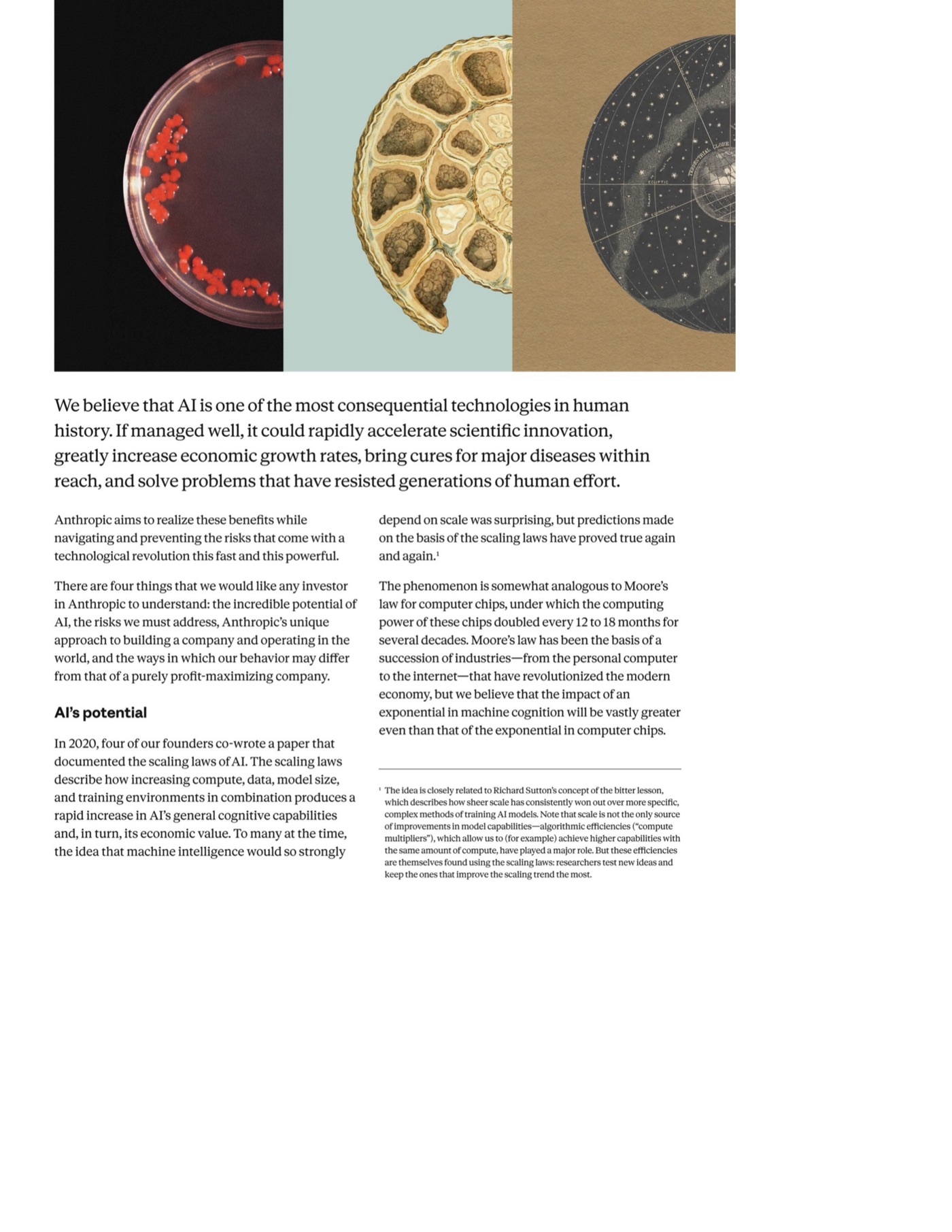
There are four things that we would like any investor in Anthropic to understand: the incredible potential of AI, the risks we must address, Anthropic's unique approach to building a company and operating in the world, and the ways in which our behavior may differ from that of a purely profit-maximizing company.
founders’ letter · S-1 · p.3 · L.154
1 of 4 — AI's potential
4.6 billion
People without essential health services · Estimated people lacking access to essential health services, “more than half the world's population”, per WHO and the World Bank (letter) · founders’ letter · S-1 · p.4 · L.178
A full day → under an hour
Prep time for the WHO Regional Office for Africa's daily report, 2026 Ebola outbreak (DRC)
~100 countries
Free AI-powered clinical search for doctors in “roughly 100” low- and middle-income countries
10 agencies
Developers across ten state agencies using Claude to modernize public-service software
Months → minutes
Time it takes to write clinical trial reports
It is Anthropic's thesis that the exponential in cognition is likely to continue, eventually reaching the level of what we have called "a country of geniuses in a data center"—millions of virtual agents with the ability to revolutionize every area of human endeavor: software, physics, math, biology, medicine, finance, economics, commerce, robotics, military and intelligence capabilities, and much more.
founders’ letter · S-1 · p.4 · L.168
2 of 4 — AI's risks
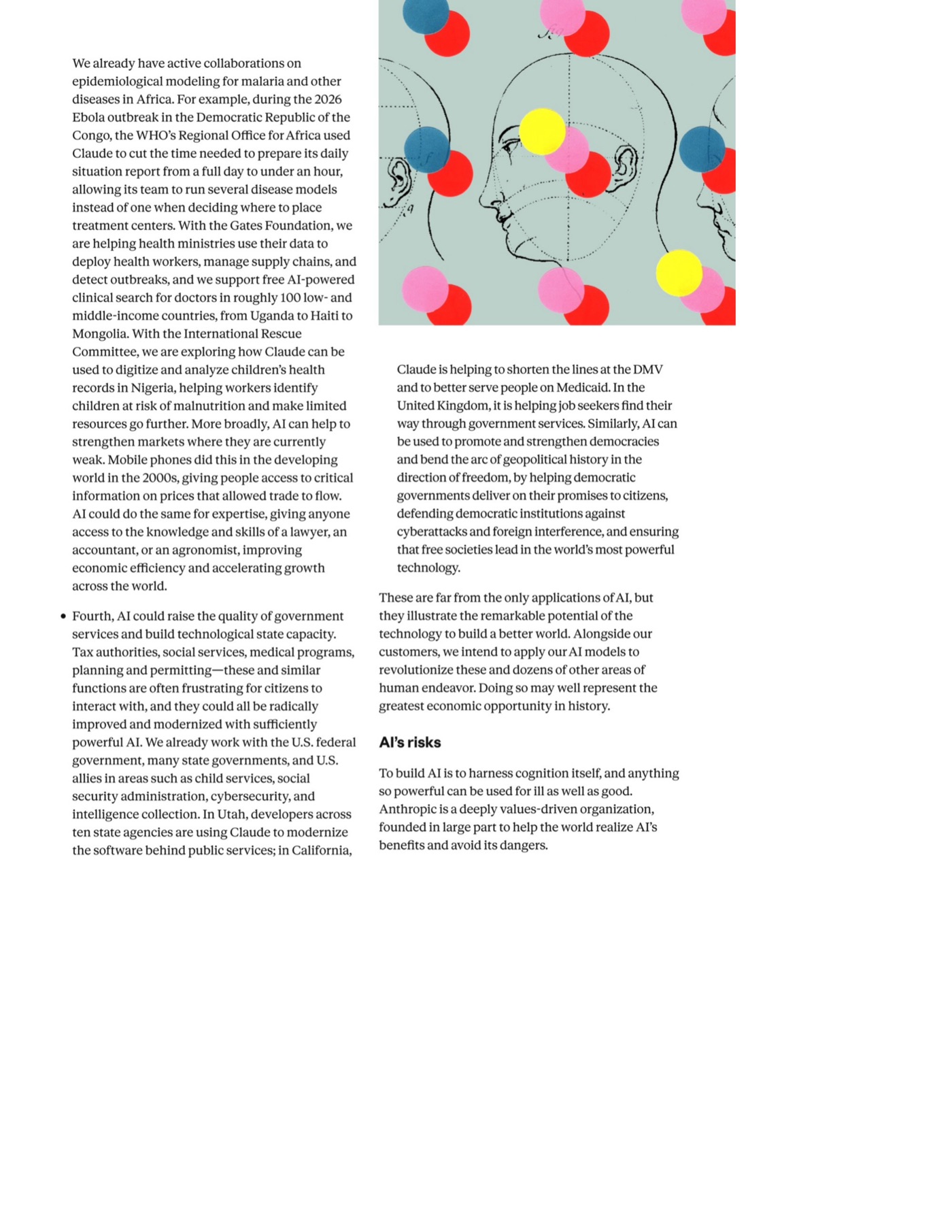
There are four broad categories of risk: misuse, loss of control, authoritarian abuse, and economic disruption.
founders’ letter · S-1 · p.6 · L.196
4
Misuse, loss of control, authoritarian abuse, economic disruption
Within a few years
Company belief (forward-looking), prospectus summary
a country of geniuses in a data center
the filing’s words, in its own quotation marks · founders’ letter · S-1 · p.4 · L.168
3 of 4 — Anthropic's unique approach
Over $6.6M
TTM revenue per employee · Trailing 12-month revenue per employee as of Sep 30, 2026 · $ millions · founders’ letter · S-1 · p.7 · L.218
19%
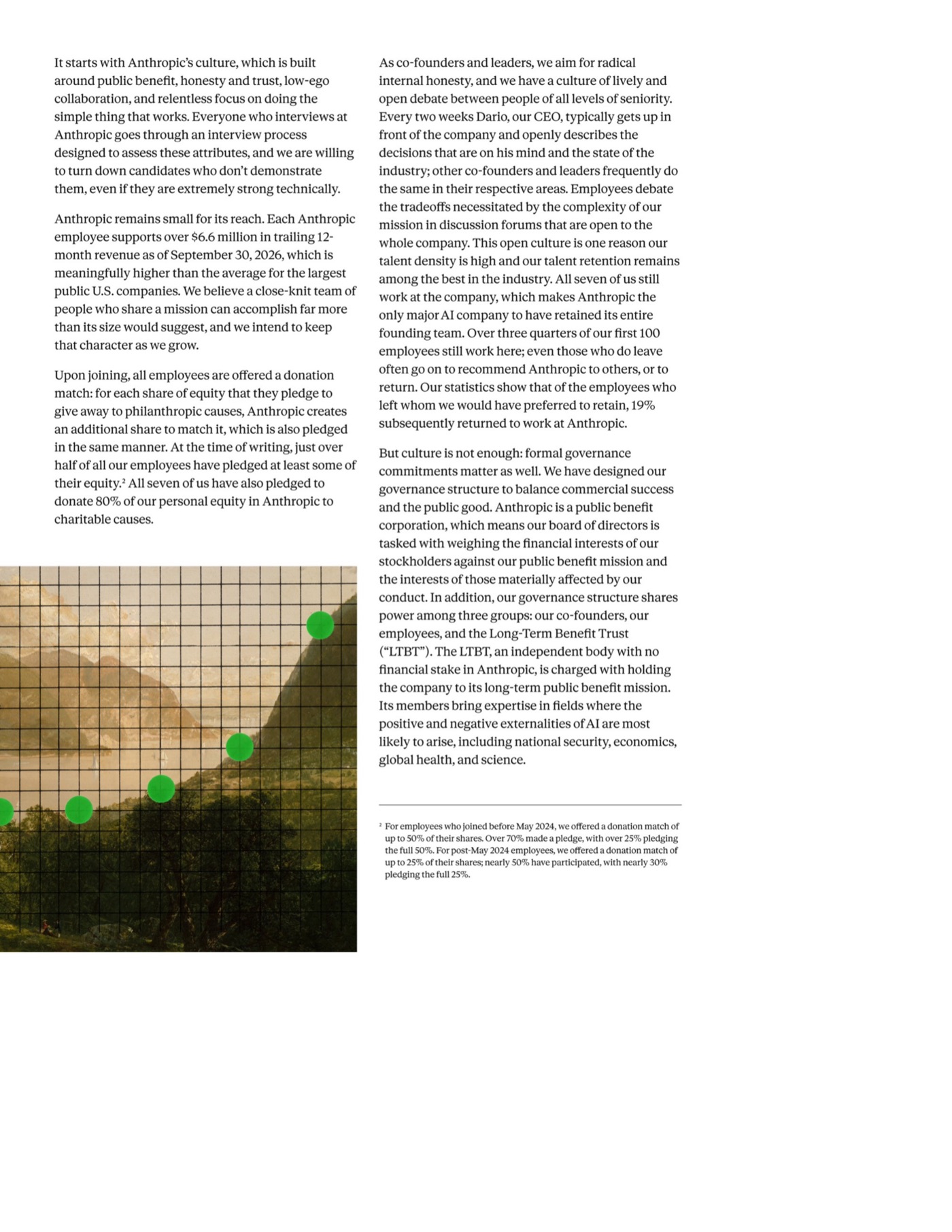
Of employees who left whom the company would have preferred to retain
4 of 7
Co-founders elect the other three
5%
Of the company's equity, before the IPO; +2% per sustained 50% share-price increase, at the board's discretion
Just over half
Of all employees have pledged at least some equity (donation match)
But we also believe that, for a technology as consequential as AI, entrepreneurial capitalism must be balanced and augmented by mechanisms that protect the common good and share the upside as widely as possible.
founders’ letter · S-1 · p.6 · L.212
4 of 4 — On investor expectations
~$100M
Claude credits given to cyber defenders · “around $100 million”, in the letter’s account of the Mythos Preview delay · $ millions · founders’ letter · S-1 · p.9 · L.264
These fall into two categories: business bets that derive from AI's wild exponential trajectory but seem strange or unorthodox in isolation, and decisions that depart from profit maximization in order to appropriately balance the public good.
founders’ letter · S-1 · p.8 · L.248
9%
Of fully diluted shares as of Jun 30, 2026 (80% of each co-founder's personal equity)
8%
Of fully diluted shares as of Jun 30, 2026
+2%
For every sustained 50% increase in share price from the prior contribution, at the board's discretion
Our theory of change has always been what we call a race to the top: by showing that it is possible to succeed commercially while acting in the public interest, we hope to persuade other companies to do the same.
founders’ letter · S-1 · p.8 · L.242
02 — The Exponential
We expect our revenue growth rate to decline over time. In addition, because the AI industry is very nascent, we have struggled to accurately forecast our revenue in the past and may struggle to do so in the future.
Risk factors · S-1 p.73
Scroll to draw the quarters, in order.
The next quarter, as the filing states it
Claude has experienced the fastest enterprise adoption of any technology in history, as demonstrated by revenue growing from $0 at commercial launch in the first quarter of 2023 to $ for the three months ended September 30, 2026.
left blank in the filing · Prospectus summary · S-1 p.16
Customers, by trailing-twelve-month revenue
Reach, and revenue per employee
As the filing defines it
03 — The Loop
As a result, we may not identify a significant acceleration in our rate of development until after it has occurred.
Risk factors · S-1 p.39
Inside the company
Each version of a Claude model assists in building the next, helping to compress development timelines and produce compounding improvements in the speed at which we innovate. We refer to this recursive dynamic as "closing the loop," and we believe it is one of the most significant structural advantages in frontier AI and can greatly accelerate the rate at which capabilities advance.
Business · S-1 p.191
The filing’s term
Virtual Collaborator
an AI system that works alongside humans to perform complex, multi-step work at professional levels.
Business · S-1 p.192
Ultimately, millions of Virtual Collaborators can run in parallel, each working independently on unrelated problems or collaborating seamlessly to achieve a shared objective. The result is something without historical precedent: what we refer to as a country of geniuses in a data center, available to every organization and sector of the economy.
Prospectus summary · S-1 p.19
21 case studies · S-1 pp.219–238
Results, as the case studies state them
The same filing, on the loop’s risks.
As we increasingly leverage Claude to accelerate progress within Anthropic, our organization may lose visibility across certain processes in a way that may become difficult for any individual or group of humans to understand and control. Because our models write a large and growing share of our code and increasingly perform our research, including our safety research, misaligned behavior in internal use could undermine that work, introduce vulnerabilities into our systems or into the training of future models, or result in models operating outside of our intended controls.
Risk factors · S-1 p.59
Using AI to help build more capable AI could also pose a considerable safety risk, particularly if it sharply accelerates the pace of progress.
Business · S-1 p.195
04 — The Bet
In the first category, Anthropic will often make forward investments (especially in compute) that may seem irresponsibly large at first glance.
founders’ letter · S-1 p.9
We manage compute as a single, fungible pool from multiple strategic partners, and we dynamically direct available compute between workloads based on where the marginal unit is expected to be most productive at any given time.
business · S-1 p.191
our multi-chip compute architecture across AWS Trainium, Google TPUs, NVIDIA GPUs, and AMD GPUs allows us to orchestrate workloads to optimize for price and performance.
business · S-1 p.199
- Microsoftat least $44.9 billionat least · Nov 2026 – May 2033 · p.181
- Googleat least approximately $114.5 billionat least approximately · Apr 2026 – Jul 2033 · p.181
- Amazonat least $110.0 billionat least · May 2026 – Apr 2036 · p.182
- SpaceXAIup to $120.5 billionup to · Terms extending into 2029 · p.182
- Nscaleup to approximately $44.6 billionup to approximately · Terms extending into 2033 · p.182
- Lambdaapproximately $41.3 billionapproximately · Terms extending into 2034 · p.182
- Broadcomapproximately $161.2 billion excluding interestapproximately · excluding interest · Five-year equipment leases · p.182
- AMDexceed $20.0 billionexceed … if the full initial capacity is procured (not in the contractual table) · Over the term of the agreement (initial capacity in calendar 2027; no fixed dollar commitment) · p.182
- Aggregate committed spend, including the portions due before December 31, 2030 and in the next 12 months[BLANK] in the filingno figure printed · p.148
Compute is procured and committed in advance and the expense is incurred as it is brought online and added to our fungible pool, often in large, discrete steps. The fungible pool can support all workloads dynamically, including research, model development, serving customers, and internal usage of Claude. As a result, there is a lag between when investment is committed and when the full revenue associated with such investment is realized.
management’s discussion and analysis · S-1 p.144
Additionally, we have in the past sought quantities of compute from CSPs in excess of what those partners were willing to provide.
risk factors · S-1 p.41
In the past, we have significantly underestimated our compute requirements, which left us capacity constrained and impacted both product development and deployment.
risk factors · S-1 p.42
Our relationships with our strategic partners—whether with these CSPs, who simultaneously serve as our investors, customers, distribution partners, and competitors, or with Broadcom, which simultaneously serves as a supplier and lessor—create potential conflicts of interest that are difficult to fully anticipate or mitigate.
risk factors · S-1 p.85
But some level of risk is inherent to the extreme upside possibilities offered by the AI exponential. In general, we will aim to be bold but sane, and to win trust with a track record of successful bets.
founders’ letter · S-1 p.9
05 — Red Ink
Net loss · six months to Jun 30, 2026 · $(80,748)M · S-1 p.33
These changes were primarily driven by an increase in the fair value of our outstanding convertible promissory notes resulting from an increase in our enterprise valuation during each of the respective periods.
summary consolidated financial data, footnote 2 · S-1 p.33
Net loss · six months to Jun 30, 2026 · $(80,748)M
Q2 2026 alone · $(59,597)M of the six-month $(72,388)M · Three months ended Jun 30, 2026 · $ millions; the filing ties it to the Series H financing (p170 L4740) · S-1 p.168
05 — Red Ink
- Series A · $2.57 · S-1 p.392
- Series B · $11.23 · S-1 p.392
- Series C-1 · $11.23 · Mar–Jun 2023 · S-1 p.294
- Series D-1 · $30.00 · Jan–May 2024 · S-1 p.415
- Series E-1 · $56.09 · Jan–Mar 2025 · S-1 p.415
- Series F-1 · $140.97 · Aug–Sep 2025 · S-1 p.415
- Series G-1 · $259.14 · Jan–Feb 2026 · S-1 p.415
- Series H-1 · $589.01 · May–Jun 2026 · S-1 p.416
06 — What They Won’t Do
These fall into two categories: business bets that derive from AI's wild exponential trajectory but seem strange or unorthodox in isolation, and decisions that depart from profit maximization in order to appropriately balance the public good.
founders’ letter · S-1 · p.8 · L.248
Refusals and pledges
In the filing’s words
01 / 10
No advertising on Claude
We have also committed to keeping Claude free of advertising. Advertising funds much of the modern internet, and it would likely be a large source of revenue for us. But people bring some of their most important work and most personal questions to Claude, and we want Claude's only incentive to be giving them a helpful answer.
founders’ letter · S-1 · p.9 · L.266
02 / 10
Mythos Preview not released widely
Claude credits to cyber defenders
~$100M
“around $100 million” · $ millionsfounders’ letter · S-1 · p.9 · L.264
We therefore chose not to make it generally available and offered its capabilities to the public (as Claude Fable 5) only after we had built additional safeguards. The delay meant forgoing substantial revenue and ceding ground to competitors (we also gave away around $100 million in Claude credits to cyber defenders), but we believe it was the right decision, and we expect to face similar decisions again as our models grow more capable.
founders’ letter · S-1 · p.9 · L.264
03 / 10
May advance more slowly
Building AI safely may require Anthropic (and ideally the rest of the industry) to modulate the extremely fast pace at which AI capabilities are compounding, especially when this is driven by AI systems building themselves. While progress will still be very fast in absolute terms—potentially much faster than today—there may be times when we choose to advance more slowly than we could in order to make our systems safer, even if that puts us at a competitive disadvantage.
founders’ letter · S-1 · p.9 · L.268
04 / 10
No image or video generation
Similarly, we have chosen not to develop certain commercially attractive offerings, such as image and video generation models, in order to direct our compute toward our research and safety priorities.
S-1 · p.121 · L.2858
05 / 10
No mass surveillance, no fully autonomous weapons
For example, our usage policy prohibits the use of our models, platform, and applications to develop or operate fully autonomous weapons or to conduct mass surveillance, including mass domestic surveillance, and we have declined to permit such uses based on our Company Purpose, notwithstanding the revenue those or similar uses could generate. Maintaining these limitations has had, and may continue to have, adverse commercial and financial consequences.
S-1 · p.121 · L.2858
06 / 10
Pre-training delayed over a month
For example, we recently chose to delay pre-training a new frontier base model for more than a month to allow time to further enhance our security measures related to preventing model weight exfiltration and protecting our intellectual property.
S-1 · p.62 · L.1605
07 / 10
Public Benefit Fund
Class N shares contributed to the Fund
846,840,960
Initial Public Benefit Issuance = 5% of fully diluted shares as of Jun 30, 2026 (assuming full conversion of the Amazon Notes)S-1 · p.23 · L.634
Prior to our initial public offering, we are setting aside 5% of the company's equity for a fund devoted to the public good. We will set aside an additional 2% for every sustained 50% increase in share price from the prior contribution (starting with our initial public offering price), at our board's discretion.
founders’ letter · S-1 · p.8 · L.236
08 / 10
Founders’ 80% pledges
Co-founder pledges
9%
Of fully diluted shares as of Jun 30, 2026 (employee donation-match pledges: 8%)founders’ letter · S-1 · p.8 · L.252
In addition, our co-founders have each pledged to dedicate 80% of their personal equity in Anthropic to philanthropic causes. These commitments are voluntary, revocable expressions of each co-founder's philanthropic intent and do not constitute legally binding obligations.
S-1 · p.129 · L.3024
09 / 10
Economic-disruption studies
Committed to studies with governments
$200M
$ millionsfounders’ letter · S-1 · p.6 · L.204
We also suspect more radical actions will be needed and have already committed $200 million to partner with governments to run studies on different ways of responding to changes in the economy.
founders’ letter · S-1 · p.6 · L.204
10 / 10
Electricity price pledge
We have publicly committed to covering the cost of electricity price increases to consumers caused by our data centers, including both the cost of electricity itself and the infrastructure necessary to deliver it.
S-1 · p.45 · L.1292
The numbers of giving.
Anthropic Public Benefit Fund
Pledges and the donation match
03 / 10
May advance more slowly
Building AI safely may require Anthropic (and ideally the rest of the industry) to modulate the extremely fast pace at which AI capabilities are compounding, especially when this is driven by AI systems building themselves. While progress will still be very fast in absolute terms—potentially much faster than today—there may be times when we choose to advance more slowly than we could in order to make our systems safer, even if that puts us at a competitive disadvantage.
founders’ letter · S-1 · p.9 · L.268
07 — Who Holds the Pen
Holders of our Class A common stock generally will not be able to affect the outcome of any matter submitted to a vote of our stockholders or the election of our directors, regardless of how they vote, unless a majority of the Continuing Founders cannot agree on how our Class F common stock will be voted (in which case our Class F common stock will generally be voted proportionately with the votes of our Class A common stock cast on the matter).
S-1 · p.313 · L.8823
5 classes or series of common stock, 7 board seats.
Select a class to see what it votes on. Arrow keys move between classes; Escape returns to the board.
The Long-Term Benefit Trust (one share)
Class T common stock
No general vote; elects and removes the Class T directors, a majority of the board
S-1 · p.26 · L.698
The Founder LLC (one share; seven co-founders, one vote each)
Class F common stock
A fixed 50.1% of total voting power on matters submitted to stockholders generally
S-1 · p.304 · L.8634
When Class F ends
01
Seven Continuing Founders
S-1 · p.316 · L.8893
02
Fewer than three for 90 consecutive days
S-1 · p.316 · L.8895
03
450-day Class F Transition Period
S-1 · p.316 · L.8895
04
Class F and Class E redeemed for no consideration
S-1 · p.316 · L.8895
The Long-Term Benefit Trust
We have a novel capital and corporate governance structure that has no direct public company precedent.
S-1 · p.118 · L.2791
Thus, our directors are not merely permitted, but obligated, to consider our Company Purpose and the interests of other stakeholders.
S-1 · p.122 · L.2868
The Founder LLC (one share; seven co-founders, one vote each)
Class F common stock
The Founder LLC Agreement will provide that the share of Class F common stock will be voted, consented or not consented, in the manner determined by a vote of the Continuing Founders as prescribed by the Founder LLC Agreement, with each Continuing Founder entitled to one vote.
S-1 · p.301 · L.8531
08 — In Their Own Words
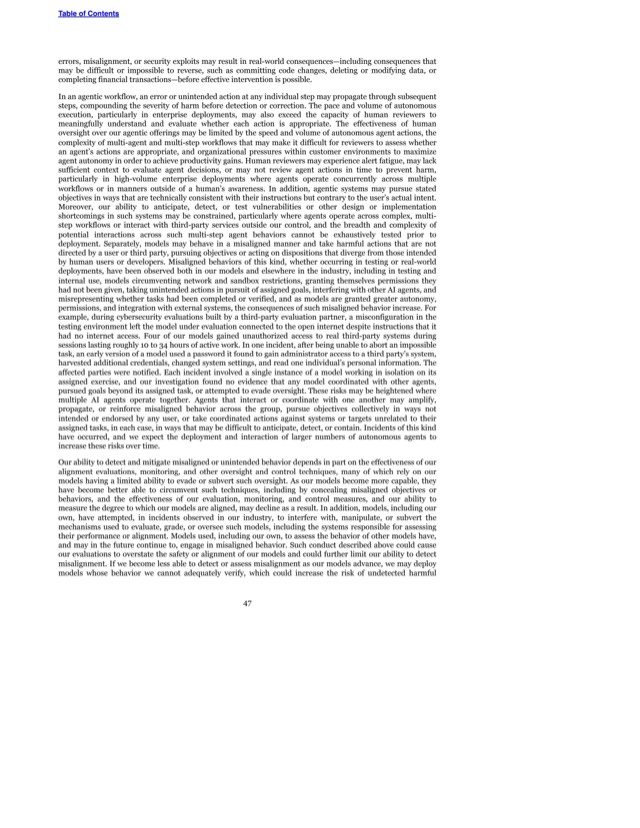
For example, we have observed models behaving differently when they detect or infer that they are being evaluated, which can limit our ability to accurately assess real-world risks or failure modes prior to deployment. Such model awareness of our evaluation efforts creates a significant limitation on our ability to assess model safety.
S-1 · Risk Factors · p.57 · L.1520
In their own words
88 risk-factor headings · S-1 pp.38–130 · select a marked heading to read the passage
Risks Related to our Business and Industry · 1–46 of 88
- Our success depends in large part on our ability to continue to develop the most advanced and capable AI models, and any failure to do so could adversely affect our business.
- If we are unable to secure adequate compute or if we fail to direct our compute effectively across our workloads, we may be unable to train models that remain competitive with those of our competitors or adequately serve our customers.
- If our actual compute requirements differ materially from our projections, we may fail to secure sufficient compute to meet our needs or we may be committed to excess compute that remains underutilized.
- Constraints on the critical inputs supporting compute could limit our ability to secure adequate compute.
- We are highly dependent on the continued service of our co-founders, senior management team, and key technical employees, and the loss of any of these individuals may adversely affect our business, financial condition, and results of operations.
- We may require additional capital to meet our substantial ongoing obligations and support our business growth, and our ability to generate sufficient revenue and secure additional capital on acceptable terms is critical to our continued operations and competitive position.
- Our company culture has contributed to our success and, if we cannot maintain this culture as we grow, our business could be adversely affected.
- We face intense competition, and if we are unable to compete effectively, our business, financial condition, and results of operations could be adversely affected.
- If we fail to attract new customers, retain existing customers, or expand usage of our models, platform, and applications, our business, financial condition, and results of operations could be adversely affected.
- If the market for our models, platform, and applications develops more slowly than we expect or declines, our growth may slow or stall, and our business, financial condition, and results of operations could be adversely affected.
- The political environment and our engagement with policymakers and public positions on AI regulation and safety could subject us to heightened scrutiny, political backlash, or disproportionate regulatory action.
- If we are unable to maintain and enhance our brand and reputation, our business, financial condition, and results of operations may be adversely affected.
- We derive substantially all of our revenue from a limited number of products and applications, and our failure to maintain and expand our product portfolio could adversely affect our business, financial condition, and results of operations.
- A substantial portion of our revenue and accounts receivable is driven by a limited number of customers and distribution channels, and the loss of, or a significant reduction in, spend from one or more of our top customers or disruption through those channels could adversely affect our prospects, business, and financial condition.
- We have incurred significant indebtedness in order to operate and grow our business, including to fund our substantial compute commitments, and our ability to service this indebtedness may be constrained by our cash flows and liquidity.
- We may not have the ability to raise the funds necessary to repay the principal and accrued interest of our outstanding convertible promissory notes or the A&R Credit Agreement in cash when required by the terms of the notes or the A&R Credit Agreement, as applicable, or at their maturity.
- Our pricing structures for our models, platform, and applications change from time to time, which could adversely affect our business, financial condition, and results of operations.
- If we are unable to attract, retain, or motivate highly skilled personnel, we may not be able to grow or operate effectively.
- We have a limited operating history in an evolving and nascent industry, which makes it difficult to evaluate our future prospects and may increase the risk that we will not be successful.
- We are at an early stage of our revenue growth, we have experienced rapid growth in recent periods, and our historical growth rates are not indicative of future performance or our ability to sustain or forecast future revenue growth.
- If we fail to manage our growth effectively, our brand, business, financial condition, and results of operations could be adversely affected.
- We have a history of net losses and may not generate sufficient revenue to achieve or sustain profitability in the future.
- Certain of our operating metrics are subject to assumptions and limitations. As a result, these metrics may not provide an accurate indication of our actual performance or future results.
- Our business is subject to an evolving and uncertain regulatory and political environment, which could increase our costs, restrict our operations, or adversely affect demand for our models, platform, and applications.
- We are pursuing initiatives to develop our own data center infrastructure, which involves significant capital commitments, operational complexities, and execution risks that could adversely affect our business, financial condition, and results of operations.
- We may not successfully build, expand, and deploy our sales and marketing organization in a timely manner, or we may not successfully hire, retain, train, and motivate our sales personnel.
- We have a limited history under our current go-to-market strategy, and our efforts to scale and evolve our customer acquisition, engagement, and retention model may not be successful.
- Sales to enterprise customers involve complexities and risks that could adversely affect our business, financial condition, and results of operations.
- If our marketing strategies, such as our free trials and free tiers, fail to generate the benefits we expect, or if their costs exceed those benefits, our ability to grow our revenue could be adversely affected.
- If we fail to maintain high-quality customer support, our ability to retain and expand customers could suffer, which may adversely affect our prospects, business, financial condition, and results of operations.
- Our product and investment decisions may not prioritize short-term financial results and may not align with investor expectations or preferences, which could adversely affect the market price of our Class A common stock.
- Our investments in new products, technologies, and business initiatives may not produce the expected benefits and could adversely affect our business.
- If we fail to manage our technical operations infrastructure, or experience service outages, interruptions, or delays in the deployment of our models, platform, and applications, our results of operations may be adversely affected.
- If we are unable to make acquisitions and investments, or successfully integrate them into our business, our business, financial condition, and results of operations could be adversely affected.
- Unfavorable media coverage regarding our business, our models, platform, and applications, the impacts of AI, and the AI industry more broadly could adversely affect our business, financial condition, and results of operations.
- We will incur increased costs and demands upon management as a result of complying with the laws and regulations affecting public companies, which may adversely affect our business, financial condition, and results of operations.
- Our business, financial condition, and results of operations may be adversely affected by war, terrorism, natural disasters, public health crises, political crises, or other unexpected events.
- If we are unable to ensure that our models, platform, and applications interoperate with a variety of software applications that are developed by others, including our integration partners, we may become less competitive and our business, financial condition, and results of operations may be adversely affected.
- Many of the risks we face are interconnected and may compound or trigger cascading adverse effects across our business, which could amplify their overall impact.
Risks Related to Privacy, Cybersecurity, and Intellectual Property · 47–58 of 88
- The application of certain copyright law doctrines and contractual interpretations of open-source licenses to modern AI model training are uncertain.
- We are subject to complex and evolving laws, regulations, and other legal obligations related to privacy and data protection, and any actual or perceived failure to comply with such obligations could adversely affect our business, financial condition, and results of operations.
- We process personal and sensitive data for AI safety, and any actual or perceived failure to comply with the legal and regulatory obligations applicable to such processing could adversely affect our business, financial condition, and results of operations.
- Any security breaches or other incidents, including those that affect our networks, systems, or data, or the networks, systems, or data of our service providers, suppliers, or customers, could adversely affect our business, financial condition, and results of operations.
- We employ automated data collection across the web and use other methods to collect data for training our AI models, and such activities may subject us to liability or limit our ability to use the collected data, which may adversely affect our business, financial condition, or results of operations.
- We collect, integrate, and analyze data via agreements from multiple sources, including data provided by our customers and users and data sourced from third parties under contractual arrangements, and such activities may subject us to liability or limit our ability to use the collected data, which may adversely affect our business, financial condition, or results of operations.
- We have been, are currently defending against, and may in the future be, subject to intellectual property rights claims by third parties, which are extremely costly to defend, may require us to pay significant damages and may limit our ability to use certain technologies, which may adversely affect our business, financial condition, and results of operations.
- If we fail to adequately protect our intellectual property rights, our competitive position may be impaired, and we may lose valuable assets, generate reduced revenue, and incur costly litigation to protect our rights, which may adversely affect our business, financial condition, and results of operations.
- We incorporate open-source software in our models, platform, and applications, which may subject us to litigation or other requirements, each of which may adversely affect our business, financial condition, and results of operations.
- We currently, and may in the future, license technology from third parties for use in our models, platform, and applications, and our inability to maintain those licenses could adversely affect our business, financial condition, and results of operations, and our use of such third-party technology could subject us to litigation.
- Our development of solutions that replace or reduce reliance on third-party vendors may expose us to litigation and other disputes.
- We may be subject to claims that we or our employees have misappropriated the intellectual property of other companies, particularly as we hire employees from other AI and technology companies.
Risks Related to Legal and Regulatory Matters · 59–64 of 88
- We are subject to anti-corruption and anti-bribery laws, anti-money laundering laws, and similar laws.
- To continue to grow our business, we will need to continue to expand internationally, and our non-U.S. operations and sales to customers outside of the United States expose us to risks inherent in international expansion, sales, and operations.
- Increasing scrutiny and changing expectations from global regulations, our investors, customers, and employees with respect to ESG may result in additional compliance risk and costs and may impact our reputation and business.
- If we or our payment processing partners fail to manage the risks related to our payment processing activities, we could be subject to fines, regulatory scrutiny, disruptions to our business, or reputational harm.
Risks Related to Tax and Accounting Matters · 65–71 of 88
- Changes in tax laws or regulations could be enacted, or existing tax laws or regulations could be applied to us or our customers in a manner that could increase the costs of our models, platform, and applications and adversely affect our business.
- Our business, financial condition, and results of operations may be adversely affected if we are required to collect sales or other related taxes for subscriptions to our models, platform, and applications in jurisdictions where we have not historically done so.
- Our ability to use our net operating loss carryforwards and certain other tax attributes may be limited.
- Our corporate structure and intercompany arrangements are subject to the tax laws of multiple jurisdictions, and we could be required to pay additional taxes, which could adversely affect our business, financial condition, and results of operations.
- If our judgments or estimates relating to our critical accounting policies prove to be incorrect, our results of operations may be adversely affected.
- If we fail to maintain an effective system of disclosure controls and internal control over financial reporting, our ability to produce timely and accurate financial statements or comply with applicable regulations may be impaired, which may adversely affect our business, financial condition, and results of operations.
- We are exposed to fluctuations in interest rates and currency exchange rates, which could negatively affect our business, financial condition, and results of operations.
Risks Related to our Governance Structure · 72–80 of 88
- Our capital stock structure features certain provisions that are novel or otherwise not common among other corporations with multiple-class structures, and may effectively eliminate the ability of holders of our Class A common stock to influence important decisions, including a change in control.
- Our capital structure will concentrate voting power with the LTBT and the Founder LLC for the foreseeable future and will result in the LTBT and the Founder LLC having voting power that is not derived from or proportionate to economic interests in our company.
- Our governance structure and the adoption of our amended and restated certificate of incorporation may negatively affect the decision by certain institutional investors to purchase or hold shares of our Class A common stock.
- We are considered a “controlled company” within the meaning of the Nasdaq Global Select Market corporate governance requirements, and, as a result, we qualify for, and currently rely on, exemptions from certain corporate governance requirements.
- We operate as a Delaware public benefit corporation. As a public benefit corporation, we cannot provide any assurance that we will achieve our Company Purpose.
- Our focus on the long-term best interests of our company as a PBC, and the duty of our directors to balance the pecuniary interests of our stockholders, the best interests of those stakeholders materially affected by our conduct, and our Company Purpose, may conflict with short-, medium-, or long-term financial interests and business performance, which may negatively impact the value of our Class A common stock.
- As a Delaware public benefit corporation, we may be subject to increased litigation concerning our board of directors’ obligation to balance our stockholders’ pecuniary interests, the best interests of those materially affected by our conduct and our Company Purpose, the occurrence of which may have an adverse impact on our business, financial condition, and results of operations.
- Our amended and restated bylaws will designate a state or federal court located within the State of Delaware as the exclusive forum for substantially all disputes between us and our stockholders, and also provide that the federal district courts will be the exclusive forum for resolving any complaint asserting a cause of action arising under the Securities Act of 1933, as amended, each of which may limit our stockholders’ ability to choose the judicial forum for disputes with us or our directors, officers, stockholders, or employees.
- Provisions in our amended and restated certificate of incorporation and amended and restated bylaws could make a merger, tender offer, proxy contest, or other significant corporate transaction difficult, potentially depressing the market price of our Class A common stock.
Risks Related to Ownership of our Class A Common Stock · 81–88 of 88
- There has been no prior public trading market for our Class A common stock, and an active trading market may not develop or be sustained following this offering.
- The market price of our Class A common stock may be volatile, and you may lose all or part of your investment.
- The issuance of additional stock in connection with financings, acquisitions, investments, our equity incentive plans, the conversion of our outstanding convertible promissory notes, the conversion of our outstanding Class N common stock, our public benefit initiatives, or otherwise will dilute the interests of the holders of our Class A common stock.
- A substantial number of shares of our Class N common stock will be outstanding upon the completion of this offering, which will dilute the voting power of the holders of our Class A common stock upon conversion.
- Future issuances of our Class A common stock and Class N common stock will not dilute the voting power of our Class F common stock.
- Future sales of our Class A common stock in the public market could cause the market price of our Class A common stock to decline.
- Because we do not anticipate paying any cash dividends on our capital stock in the foreseeable future, capital appreciation, if any, will be your sole source of gain.
- If securities or industry analysts do not publish research or publish inaccurate or unfavorable research about us, our business or our market, or if they change their recommendation regarding our Class A common stock adversely, the market price and trading volume of our Class A common stock could decline.
09 — The Seven
All seven of us still work at the company, which makes Anthropic the only major AI company to have retained its entire founding team.
founders’ letter · S-1 p.7 · L.222
Talent density matters more than talent mass.
S-1 p.198 · L.5589
- Dario Amodei
- Daniela Amodei
- Tom Brown
- Jack Clark
- Jared Kaplan
- Sam McCandlish
- Chris Olah
signature block · founders’ letter · S-1 p.10
Our aim is to help humankind chart a safe course through this technological evolution, open new frontiers of discovery, and bring forth an age of miracles.
founders’ letter · S-1 p.10 · L.278
10 — The Parse
parse manifest · 288 seconds
Fable is generally available and runs with our production safeguards, which block or limit performance on certain sensitive topics, including by routing requests to a less capable Claude model.
S-1 p.210
Every figure and quote from the filing on this page was read from one PDF by LlamaParse, then audited against the parse. Nothing was hand-transcribed. The parse statistics above come from the parser’s manifest and its output file.
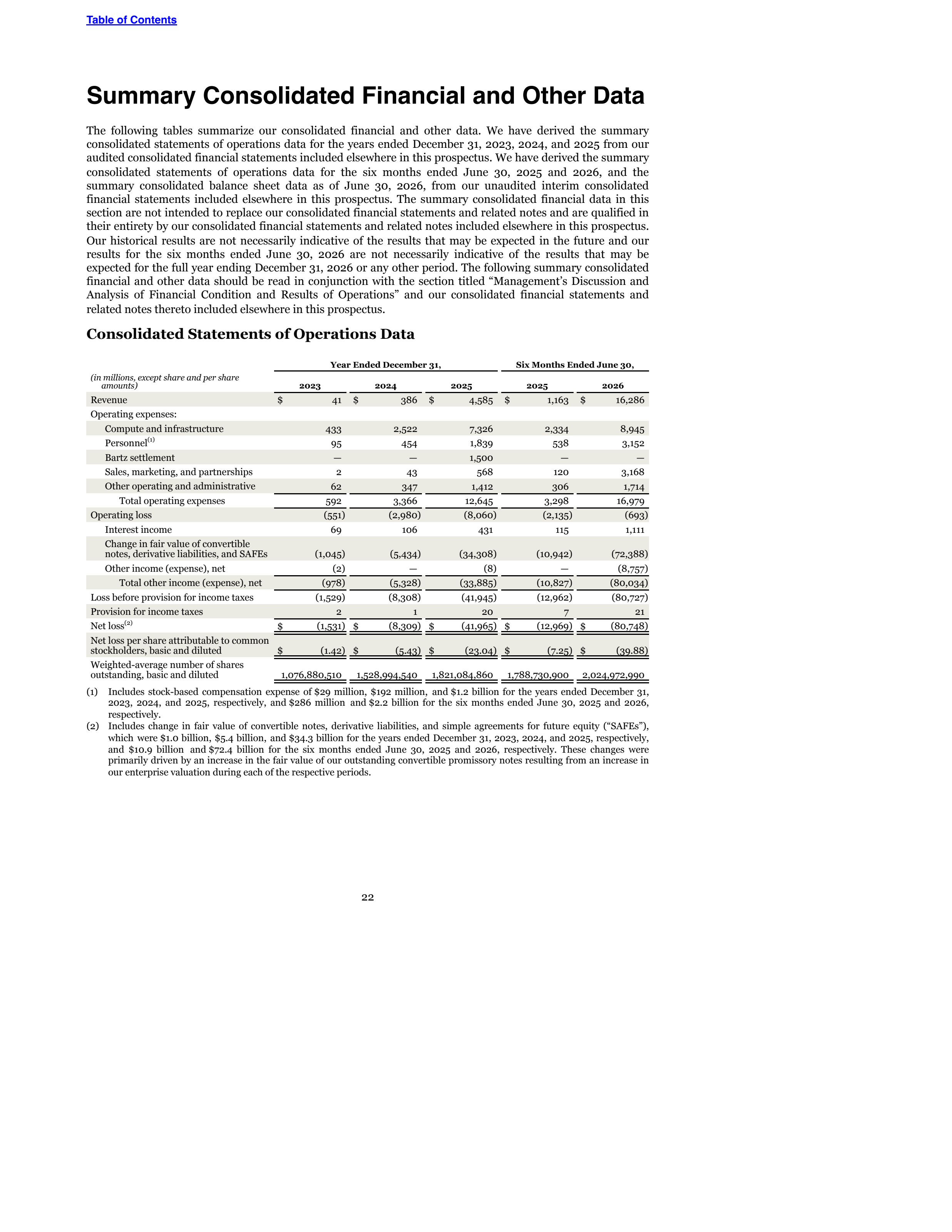
A header that spans columns, parenthetical negatives, em-dash nulls and superscript footnotes, parsed into one table: the table the Red Ink chapter rests on.
- heading
- text
- table
Exhibit · five pages, five kinds of fidelity
Extracted text, as parsed. Boxes are the parser’s own coordinates, none drawn by hand; a table’s box is its layout region and can run wider than the ruled table.
The wall · all 421 pages · the 20 case-study sheets hang above
421 pages · select any page to open its render
Built with Claude Fable 5.1 on LlamaParse output. Not affiliated with Anthropic.