
SPACEX
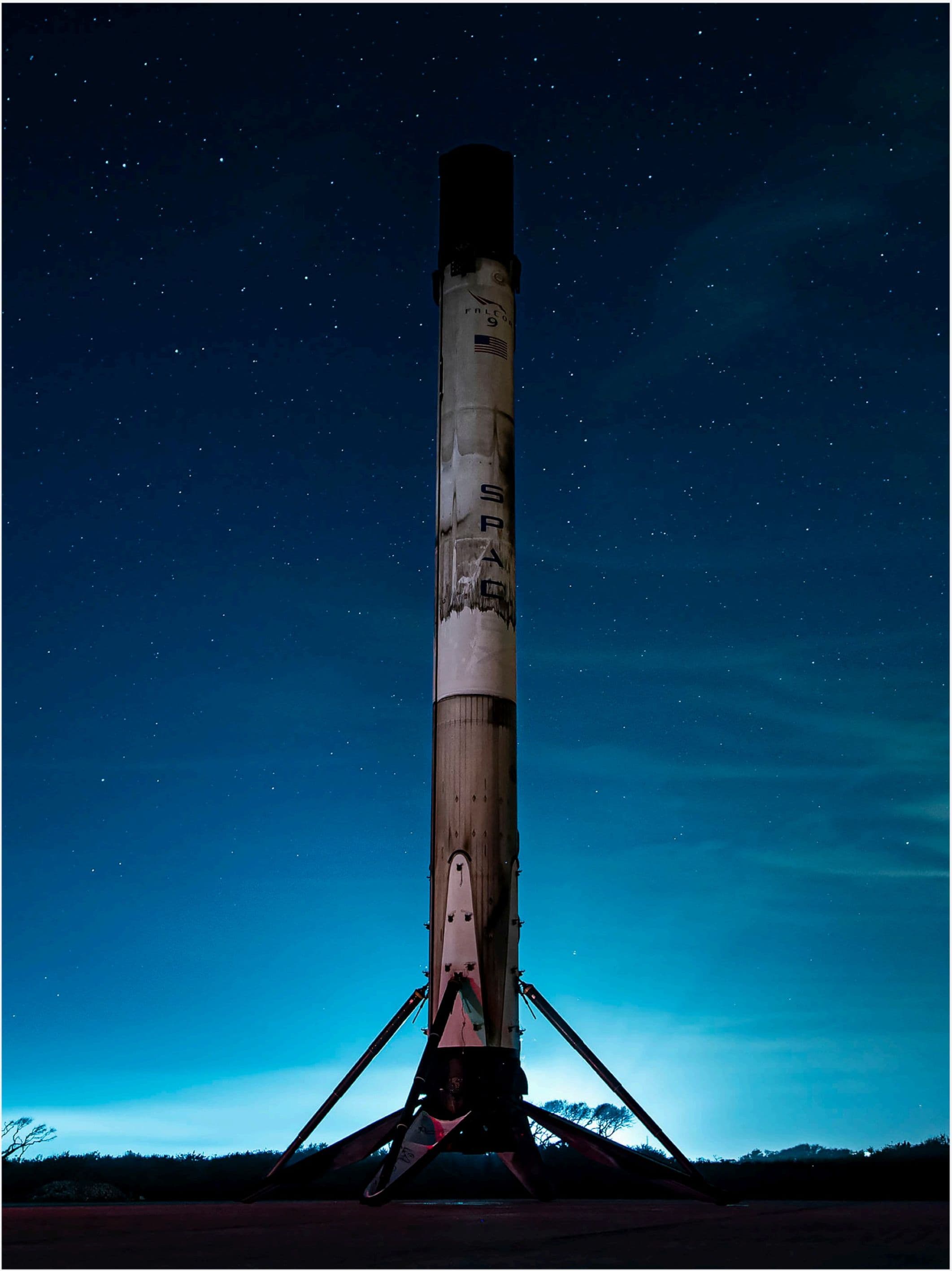
A flight-proven Falcon 9 first stage standing upright on its landing legs, scorched from reentry, beneath a star-filled twilight sky.
U.S. SEC·Form S-1·Filed May 20, 2026
Independent visual reading·Not affiliated with SpaceX
Scroll to begin
Dossier

The filing, in numbers.

SpaceX files publicly for the first time. Three business segments — Space, Connectivity, and AI. Eighteen point seven billion dollars in revenue. Four point nine billion in net loss. And one mission that hasn't changed since 2002.

2025 Revenue
$18.7B
+33% YoY
2025 Net Loss
($4.9B)
Accumulated deficit: $41.3B
Starlink subscribers
10.3M
Across 164 countries
Satellites in orbit
9.6K
75% of all maneuverable sats
Orbital launches
650.0
99%+ mission success
Mass to orbit (2025)
2.2K t
80%+ of global mass to orbit
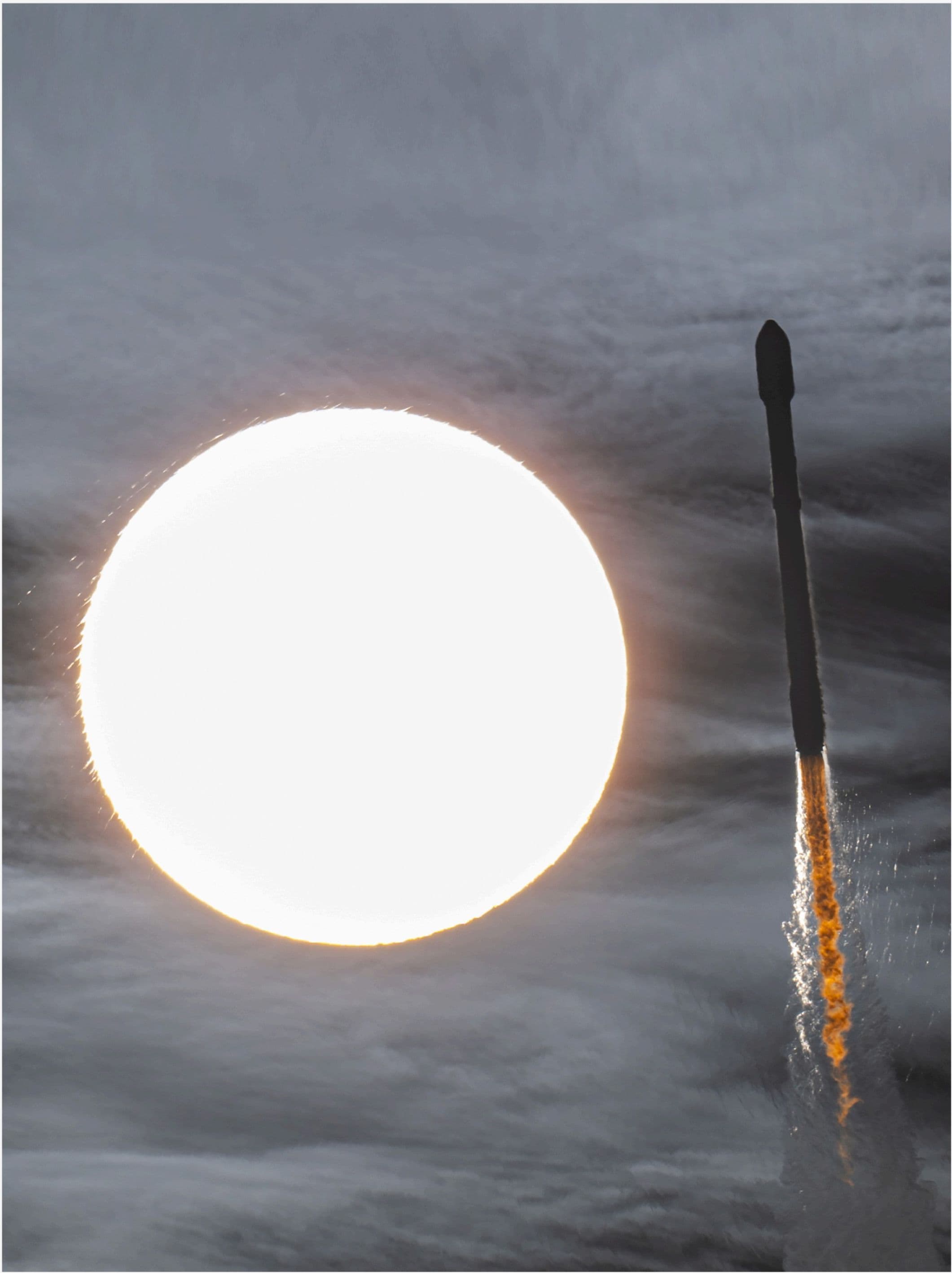
A Falcon 9 rocket ascending past a glowing sun seen through thin cloud — a silhouette against the disc.
Chapter I

Mission

Chapter IThe thesis the company has not changed in twenty-four years

One mission. Stated plainly.

The S-1 opens with a sentence written for engineers and a quote written for everyone else. Both make the same case: that the species needs a second address, and that a private company is best positioned to provide it.
Statement
S-1, page 1
Our mission is to build the systems and technologies necessary to make life multiplanetary, to understand the true nature of the universe, and to extend the light of consciousness to the stars.
Expansion
Same paragraph

To do this, we have formed the most ambitious, vertically integrated innovation engine on (and off) Earth with unmatched capabilities to rapidly manufacture and launch space-based communications that connect the world, to harness the Sun to power a truth-seeking artificial intelligence that advances scientific discovery, and ultimately to build a base on the Moon and cities on other planets.

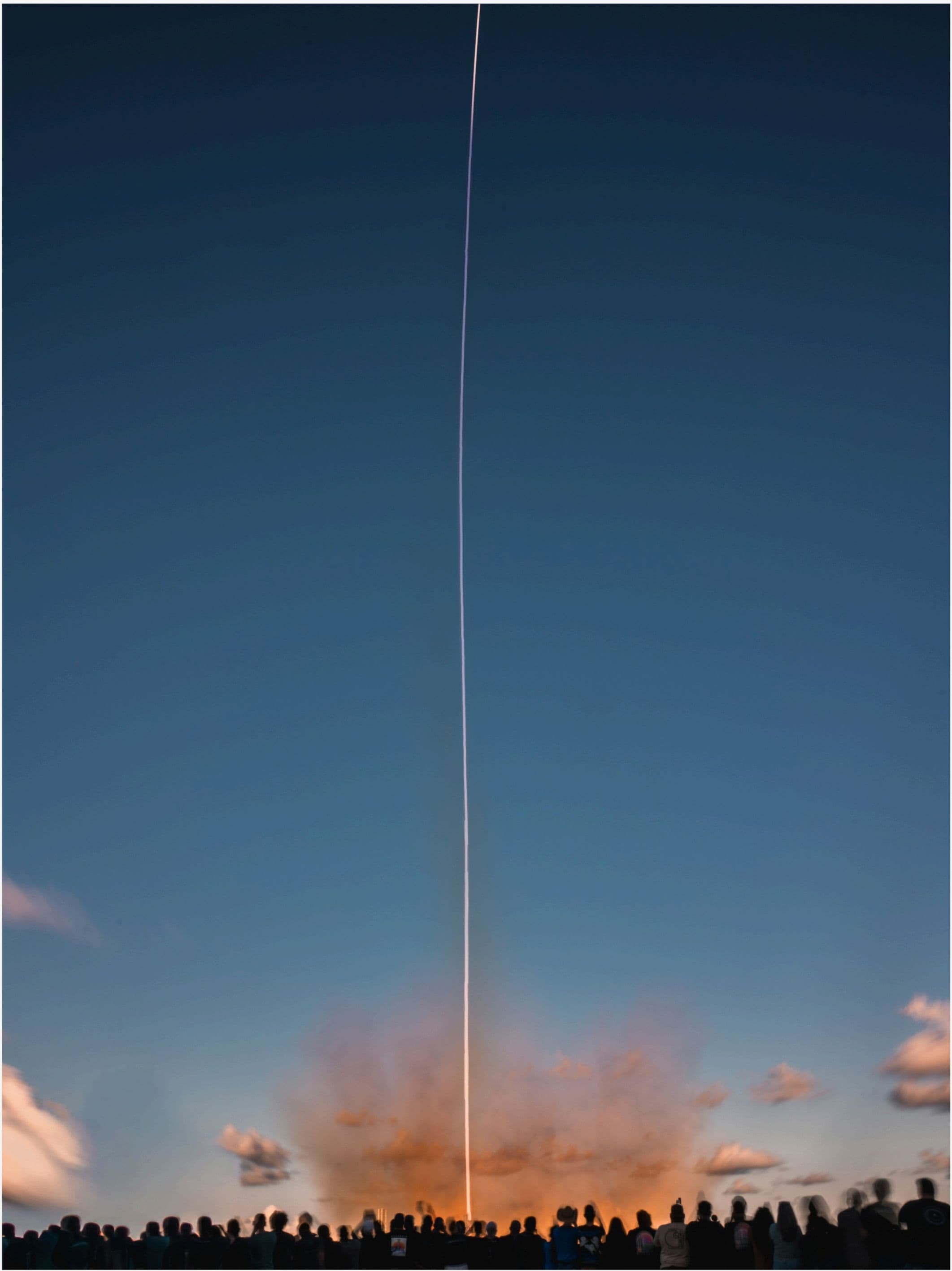
A vertical contrail rising thousands of feet against blue twilight, with silhouettes of a small crowd watching at the bottom.
Scene 01Why this matters now

A single planet is a single point of failure.

The S-1 frames the company's entire existence as an engineering response to one fact: for the whole of human history, civilization has lived on one celestial body. The risks are unpredictable on a planetary scale — asteroid impacts, volcanic activity, solar fluctuations, man-made conflict.

The line they keep returning to reads like a software postmortem: existential risk with a probability of one that must be solved.

We do not want humans to have the same fate as dinosaurs.
SpaceX S-1“Why This Matters Now” · p. 136
Scene 02 — The Sun

Earth's grid is running out of electricity. The Sun is not.

U.S. electricity generation grew at a 0.1% compound annual rate from 2008 to 2023. AI compute demand is doubling. The S-1's solution is to move the data centers up — to a continuously illuminated solar array in orbit.

The Sun contains approximately 99.8% of the solar system's energy and, as a result, we believe it is the only truly scalable solution to terrestrial energy constraints in the age of AI.
Prospectus Summary · p. 4
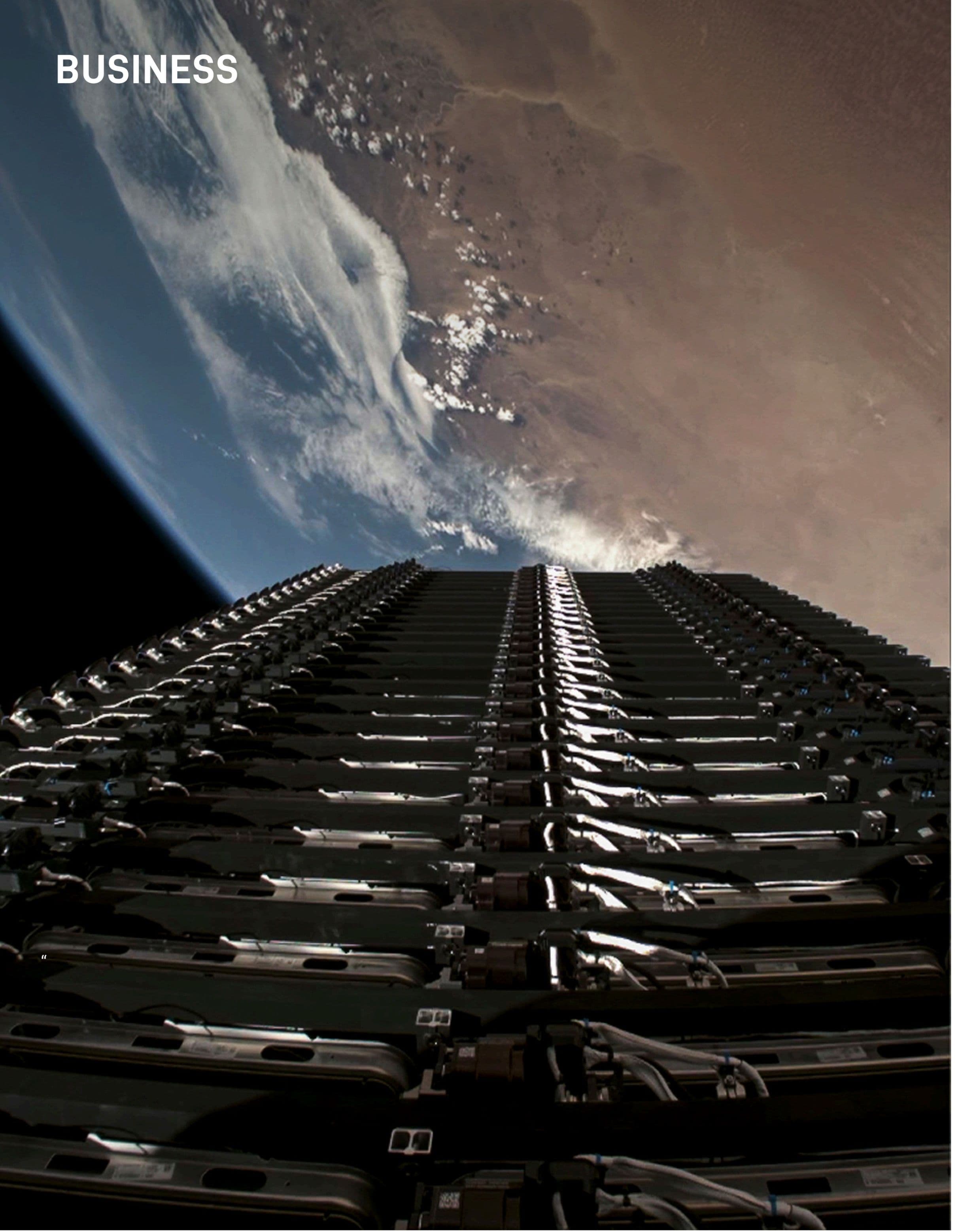
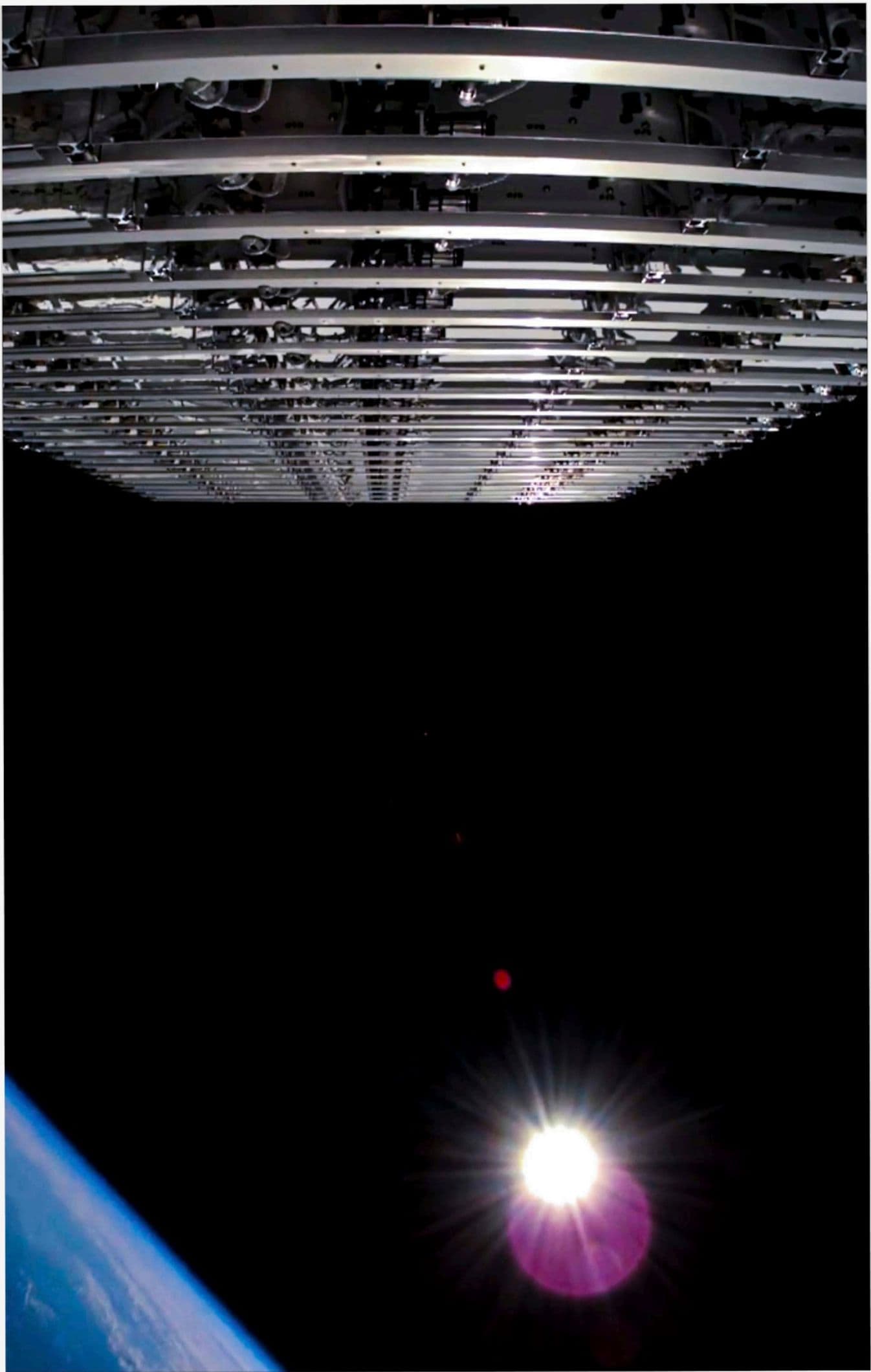
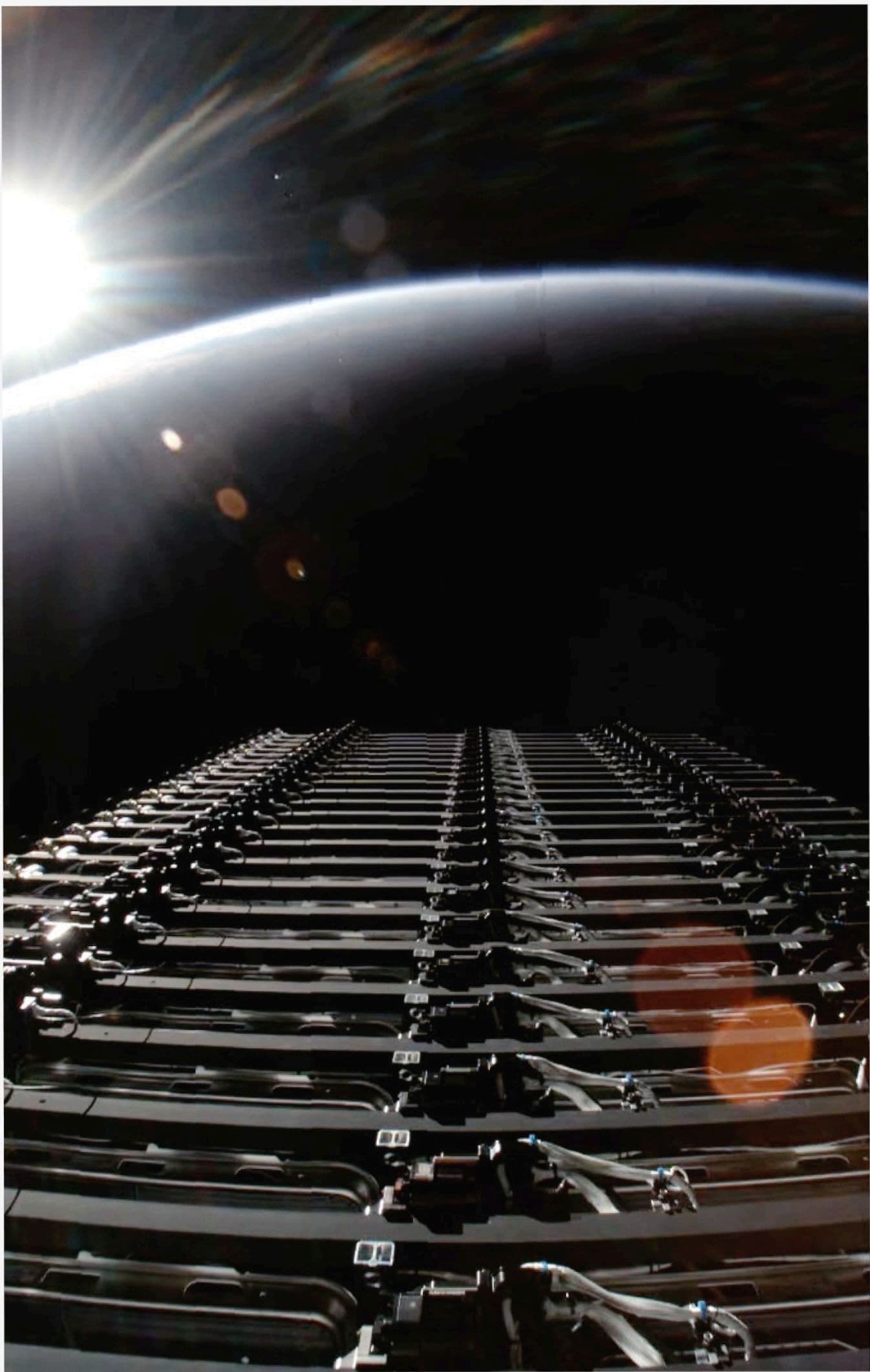
View from beneath a deployed Starlink satellite stack in orbit; the edge of Earth visible at lower left, sun-flare in frame.
Starlink satellite stack on orbit. From the SpaceX S-1.
The next paradigm shift for humanity is the creation of a resilient, perpetually expanding spacefaring civilization that drives continuous innovation across new frontiers, ultimately propelling us to Kardashev Type II status.
SpaceX S-1“Why This Matters Now” · p. 138
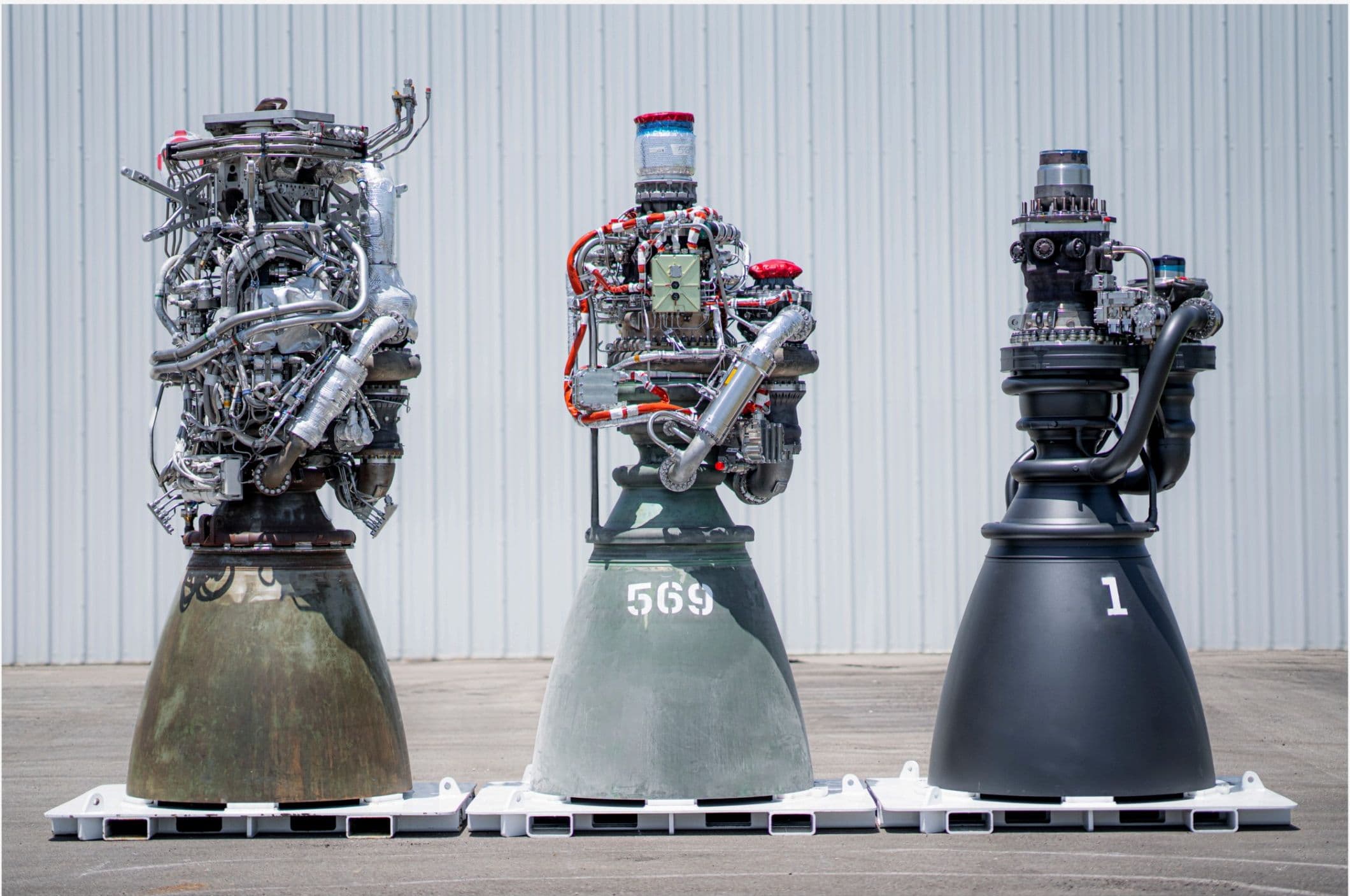
Three rocket engines side-by-side on white pallets — a silver early model, a green mid-generation engine numbered 569, and a black Raptor numbered 1.
Chapter II

The Algorithm

Chapter IIHow a hardware company moves at software speed

Five steps. Repeated forever.

The S-1 reproduces, verbatim, the five-step internal process behind SpaceX engineering. Most companies leave their secret sauce out of the prospectus. SpaceX puts it on page 135.
01
Step 01 of 05

Make the requirements less dumb.

Half the things you’ll be asked to build shouldn’t exist. Question every constraint — especially the ones that look like physics but are really just convention.

02
Step 02 of 05

Delete the part or process step.

The best part is no part. The best process is no process. Add only after deletion has been tried first.

03
Step 03 of 05

Optimize.

Optimize what survives. Not before — premature optimization is the larger waste.

04
Step 04 of 05

Accelerate.

Cycle time is the input to learning. The faster you iterate, the more reality teaches you.

05
Step 05 of 05

Automate.

Only the proven processes get automated. Automation is amplification; amplifying a flawed process is a flawed process at scale.

The Algorithm
01 / 05
Note

A set of core execution principles the filing refers to as “The Algorithm” — a five-step iterative process used as day-to-day guidance. Make the requirements less dumb, delete unnecessary processes or parts (embracing the principle that the best part is no part), only then optimize the necessary processes or parts, accelerate cycle time, and automate only proven processes after the first four steps are completed.

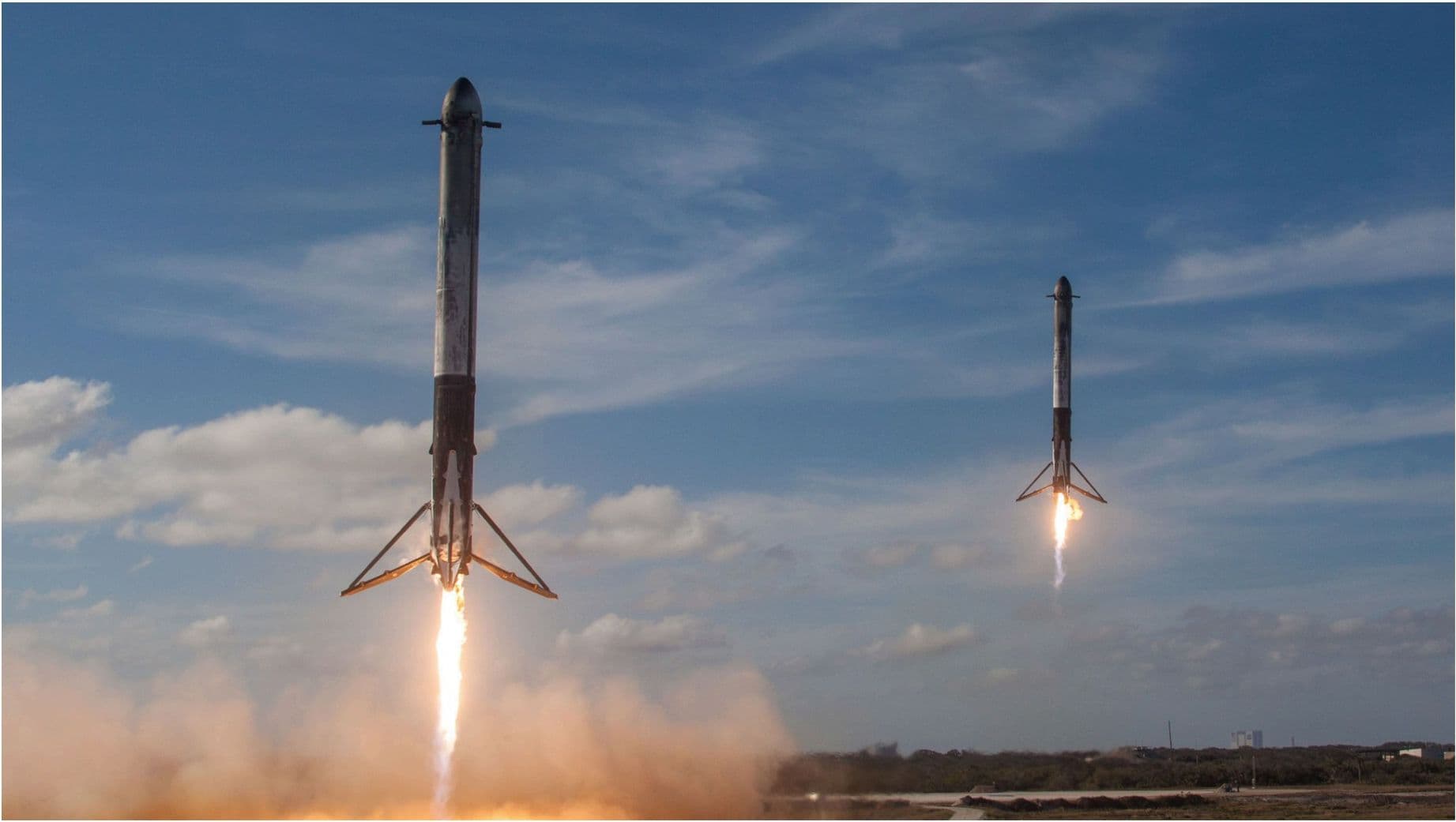
Two Falcon 9 boosters touching down simultaneously side-by-side after a Falcon Heavy mission.
Chapter III

Launch

Chapter IIIThe engine the rest of the company rides on

One company. Eighty percent of orbit.

80%
of global mass to orbit, 2025
Before Falcon 9 first flew, the filing notes, global commercial launch activity averaged twenty-five to thirty-five attempts a year. SpaceX did one hundred and seventy missions across Falcon and Starship last year on its own. The line on the chart looks like a software product. It is not.
Orbital launches
650.0
>540 by flight-proven boosters
Mission success
99%
Across Falcon family
Max booster reflies
34.0
Falcon 9, single first stage
Mass to orbit
7.4K t
Cumulative, all time
Scene 01The hockey stick

Two launches in 2010.
One sixty-five in 2025.

Reusability changed the unit economics; reliability changed the schedule. The S-1 shows the same data SpaceX shows its own employees: annual Falcon launches over time, with the number of new boosters flown each year overlaid on top.

The launches go vertical. The new-booster bars stay flat. The gap between the two is the entire story of modern rocketry.

Fig. 01Falcon family — annual launches vs. new boosters flown.
S-1, p. 140
Scene 02Mass to orbit (metric tons)

Two thousand two hundred and thirteen tons. In one year.

SpaceX delivered 2,213 metric tons of payload to orbit in 2025 — more than eighty percent of the global total.

Q1 2026 alone: 556 tons. The annualized run rate is approaching three thousand.

Fig. 02Mass to orbit, by period (metric tons).
Annual
Q1
S-1, p. 86
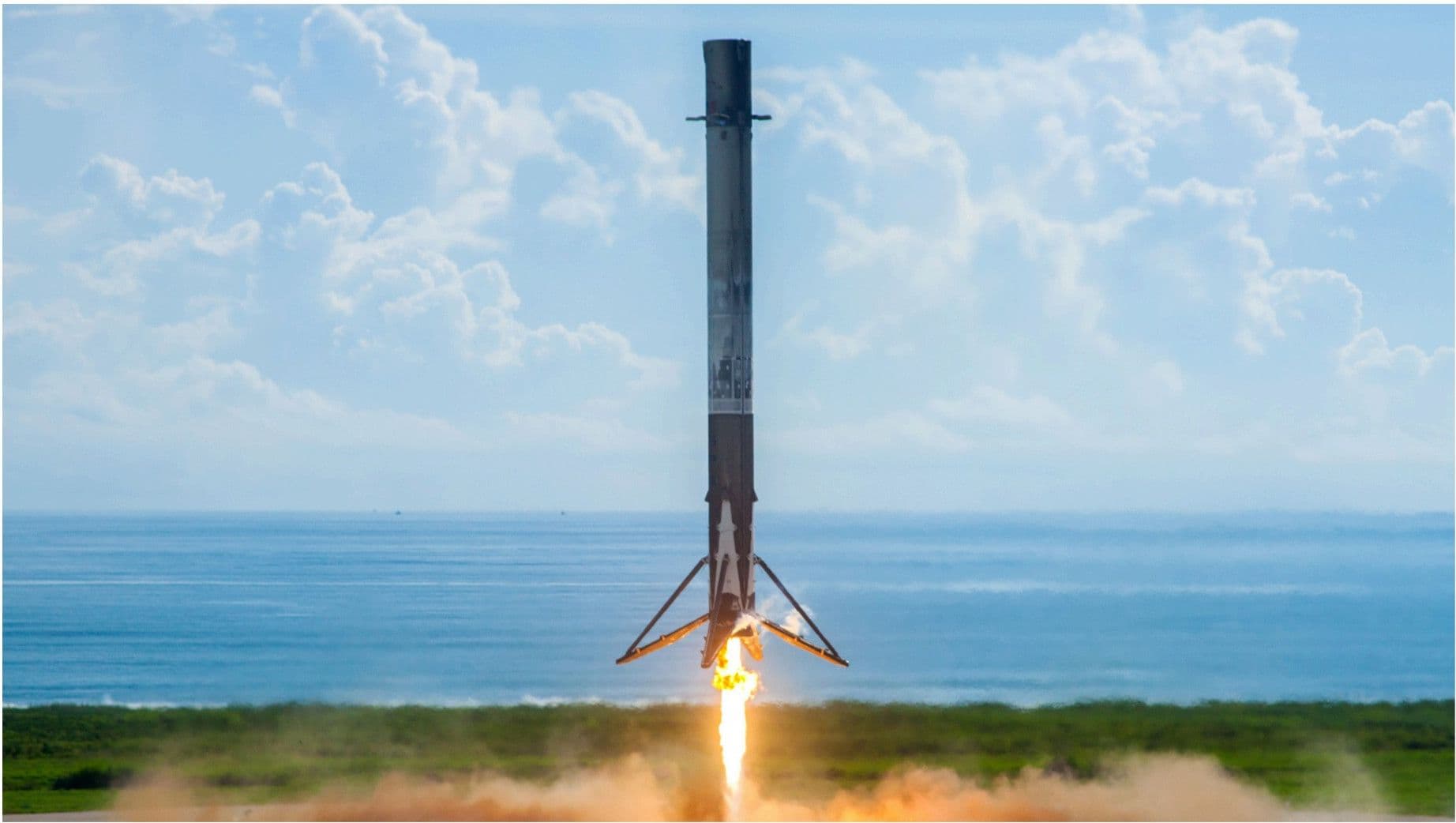
A Falcon 9 booster touching down vertically on a green coastal landing pad with the ocean horizon behind.
We believe rocket launches and landings should be as routine and commonplace as airplanes taking off and landing.
SpaceX S-1Business · p. 131
Scene 03 — December 21, 2015

The inciting incident.

Thirteen years after the company was founded, the first orbital-class booster came home and landed under its own power. The S-1 calls it “a 10-year lead.” From that night onward, everything became a balance-sheet question.

In December 2015, we achieved what many deemed impossible: landing a rocket launched to space back on Earth.
SpaceXS-1 · p. 139
A Falcon 9 first stage standing on its landing legs under a starry twilight sky, scorched from reentry.
Falcon 9 first-stage booster landing. From the SpaceX S-1.
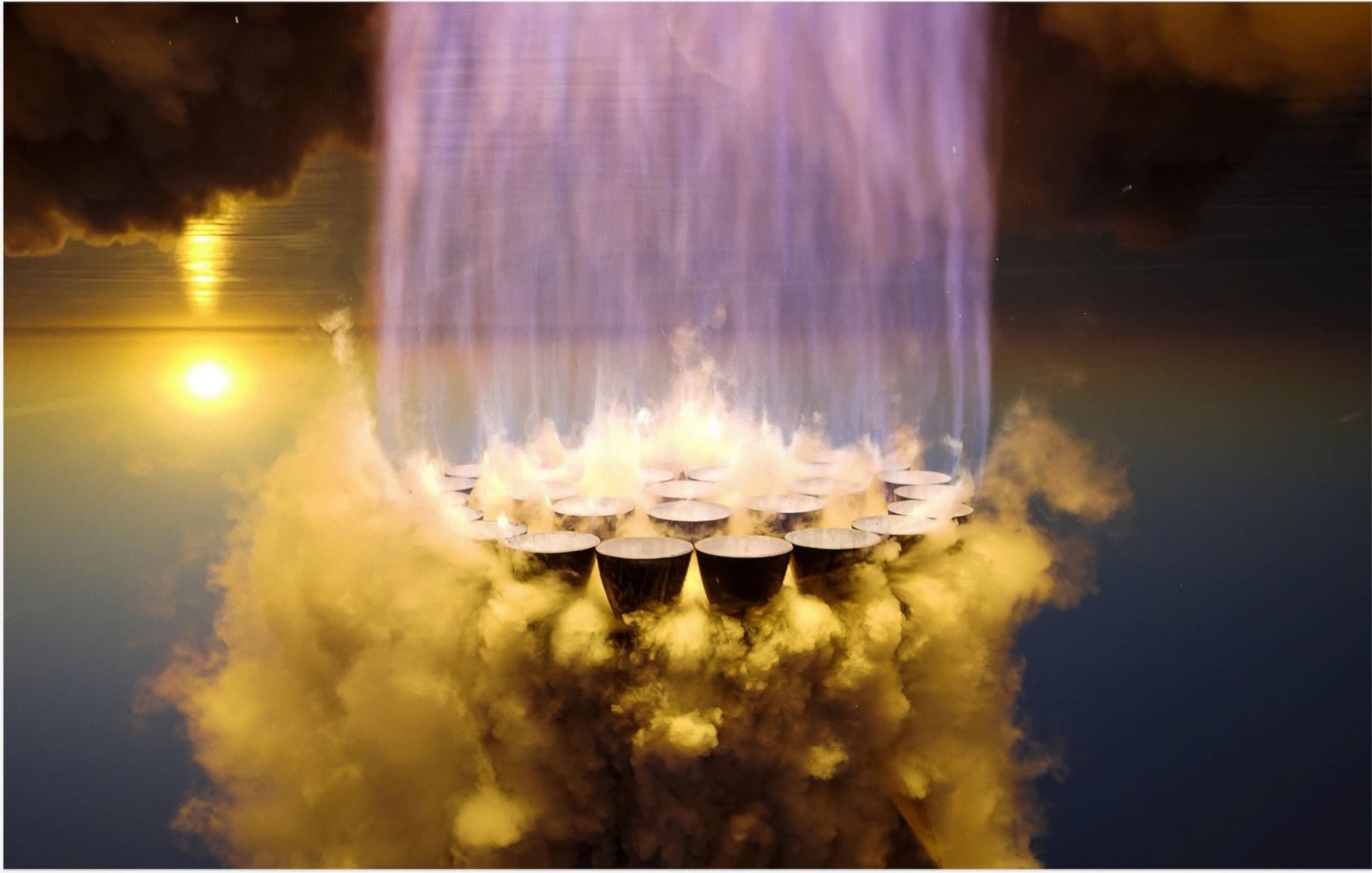
A Starship Raptor engine cluster at full throttle, sunlit exhaust plume rising from the engine bells against a sunset horizon.
Raptor engines at full throttle. From the SpaceX S-1.
Scene 04 — Cost per kilogram

From $18,500 to $1,400.

According to NASA, the historical average launch cost was $18,500 per kilogram. Falcon 9, on its first flight in 2010, brought it to $2,700. Falcon Heavy: $1,400. Starship is targeting a further 99% reduction from the historical average.

Historical avg
$18,500
per kg
Falcon 9 (2010)
$2,700
−85% vs. historical
Falcon Heavy
$1,400
−92% vs. historical
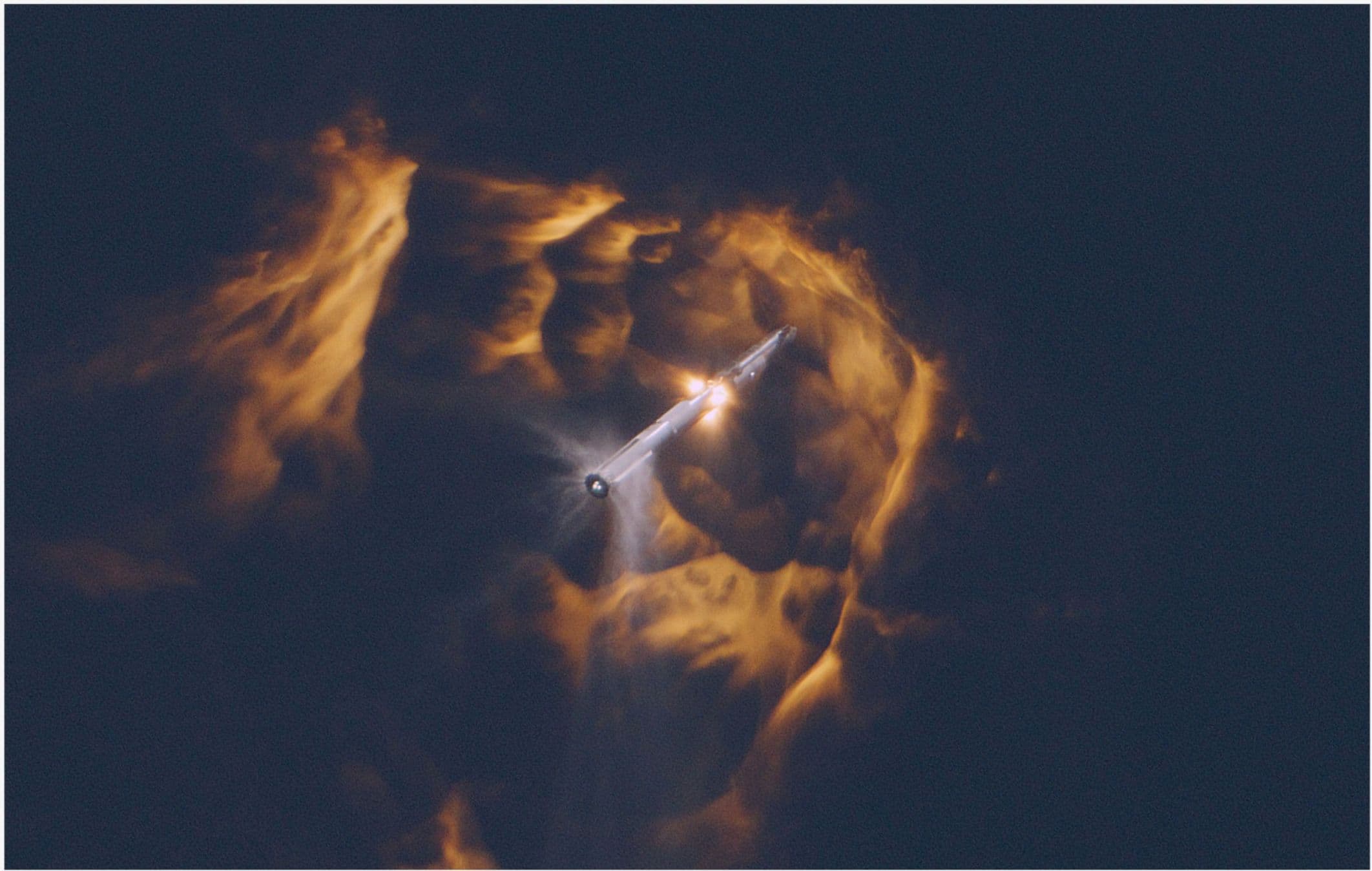
Starship punching through orange cloud formations from below, engine plume cutting a tunnel through clouds.
Starship in flight. Target: 99% cost reduction vs. the historical $18,500/kg average (S-1, p. 5).
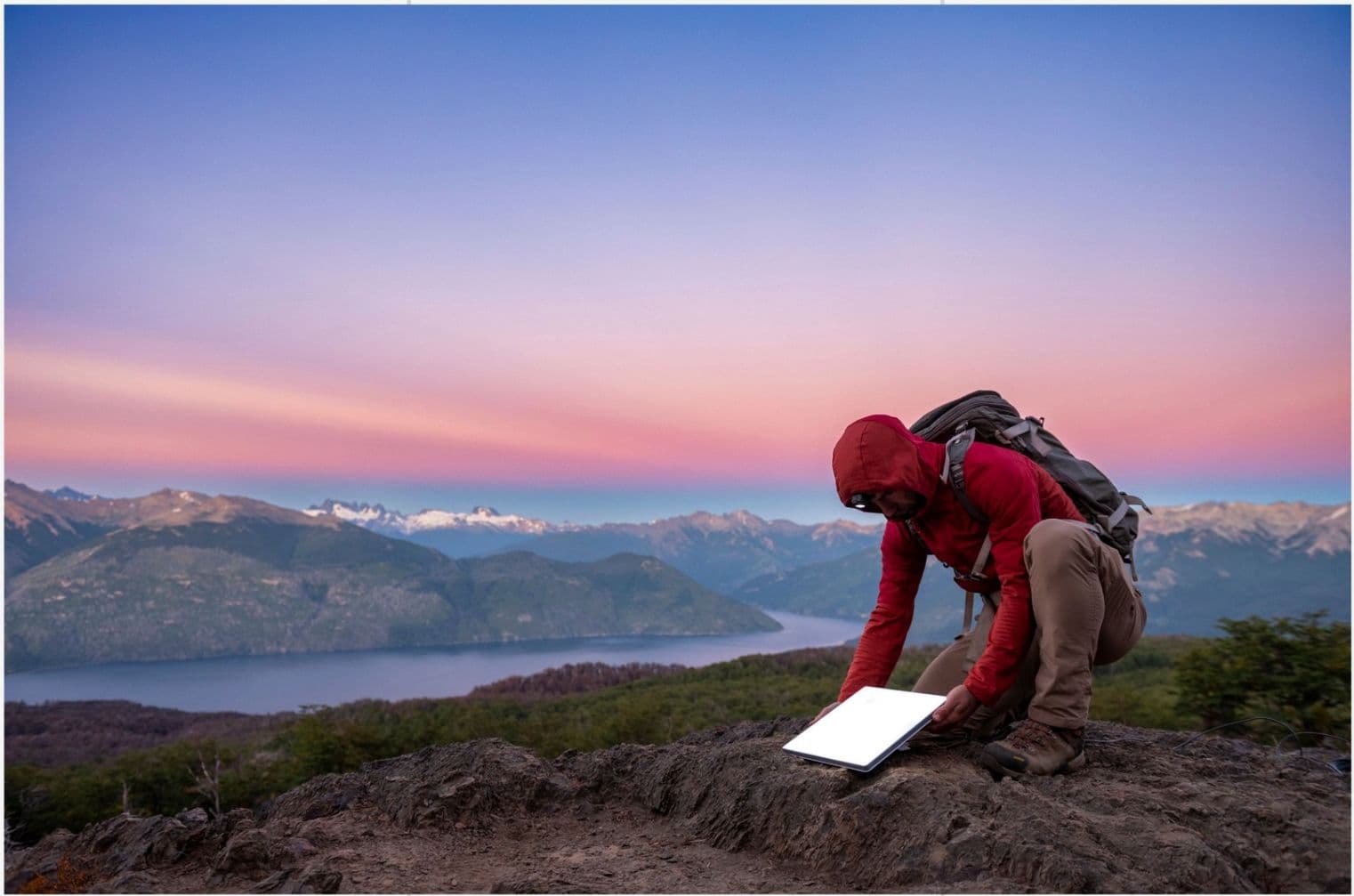
A hiker in a red jacket on a mountain ridge at dusk over a tablet, snow-capped mountains and lake behind, pink-purple sky.
Chapter IV

Connectivity

Chapter IVThe product that quietly funded everything else

Ten point three million customers. In one hundred and sixty-four countries.

$11.4B
2025 Connectivity revenue
Starlink began with a single satellite launch in 2019. By the end of Q1 2026 it counted ten point three million subscribers across 164 countries — the world's largest low-Earth-orbit broadband constellation, with roughly seventy-five percent of every maneuverable satellite in orbit.
Satellites in orbit
9.6K
Subscribers (Q1 2026)
10.3M
Countries served
164.0
2025 EBITDA
$7.2B
+86% YoY
Scene 01Subscriber growth

From 2.3M to 10.3M in three years.

The S-1 reports subscriber counts as of each year-end and quarter-end. The Q1 2026 figure of 10.3 million is more than double the same quarter the year prior.

That number includes ~7.4 million monthly unique devices on the satellite-to-mobile constellation — partners with roughly thirty mobile network operators across six continents now route around dead zones via SpaceX.

Fig. 03Starlink subscribers, annual + Q1.
Annual
Q1
S-1, p. 88
Scene 02ARPU

More customers, less revenue each.

The trade is visible in the numbers. Annual ARPU has fallen from $99/mo in 2023 to $81/mo in 2025. Q1 2026 ARPU dipped to $66/mo.

The reason: aggressive expansion into lower-income markets and the rollout of the cheaper Starlink Mini and Starlink Mobile tiers. Subscriber growth more than compensates — Connectivity revenue is up +49.8% year-over-year and Segment EBITDA +86.2%.

Fig. 04Starlink monthly ARPU.
Annual
Q1
S-1, p. 88
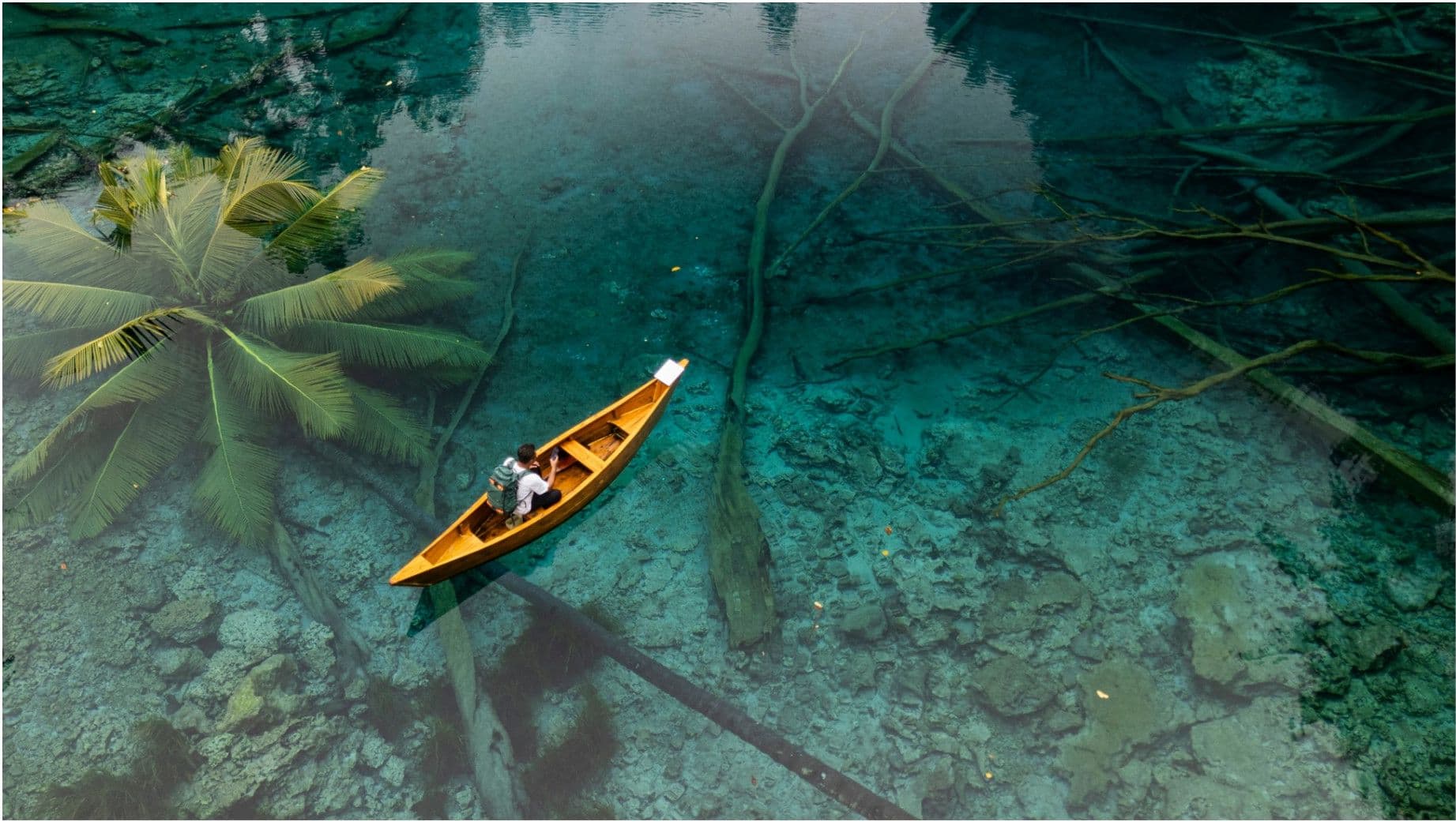
A person paddling a wooden canoe on glassy turquoise water with a Starlink Mini visible aboard.
From Antarctica's frozen wilderness to vast oceans and towering mountaintops — overcoming barriers posed by traditional terrestrial infrastructure.
SpaceXS-1, p. 137
Scene 03 — The cash engine

The only profitable segment.

In 2025 Connectivity produced $11.4B of revenue and $4.4B of operating income. The Space segment swung from black to red as it ramped Starship. The AI segment burned six and a half billion.

Starlink is what the rest of the company is paid for with.

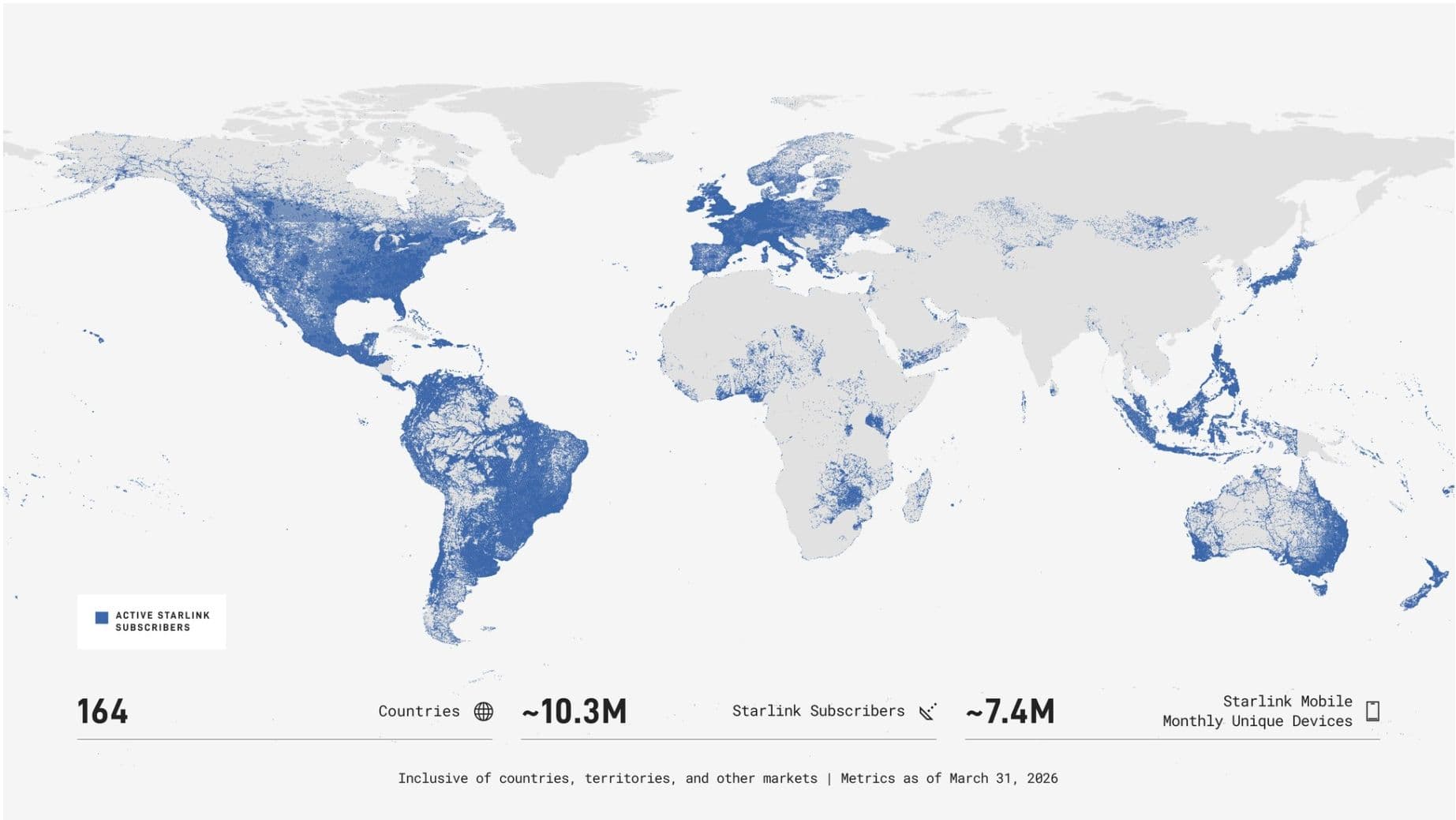
A world map showing Starlink subscriber density across 164 countries, with metrics overlaid.
Starlink coverage and subscriber density, as of March 31, 2026.
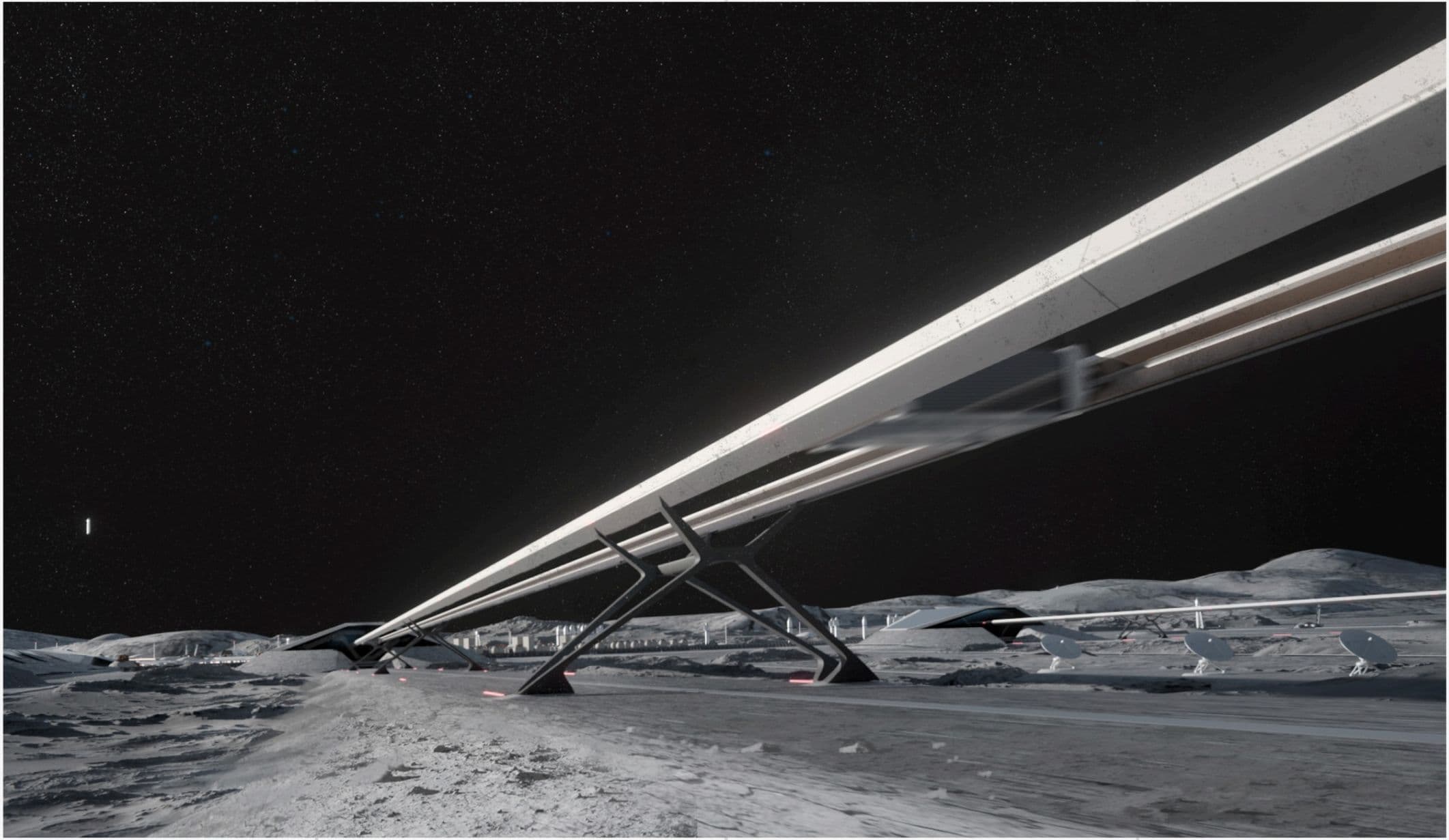
A rendering of a sleek lunar high-speed track or mass driver under a star-filled sky with mountains in the distance.
Chapter V

AI

Chapter VThe segment that didn’t exist a year ago

xAI was bought in February. The IPO followed in May.

1.0 GW
Nameplate compute draw, Q1 2026
In early 2026 SpaceX absorbed xAI. With it came Grok, X, and the COLOSSUS data centers. The S-1 names this third segment AI, then explains that the bottleneck of intelligence is no longer software. It is steel, silicon, and power.
2025 AI revenue
$3.2B
2025 AI op. loss
($6.4B)
2025 AI capex
$12.7B
Compute draw
1.0 GW
The key constraints in the continued growth of AI are physical — chip manufacturing, data center infrastructure, and power generation. The future of AI will be determined by the control of the physical stack.
SpaceX S-1Prospectus Summary · p. 6
Scene 01Compute draw (gigawatts)

From zero to a gigawatt. In six quarters.

COLOSSUS came online in 122 days. COLOSSUS II in 91 days. The first cluster of COLOSSUS II — 110,000 GB200 chips drawing 210 MW — was operational in roughly the time it takes a normal data center company to write the environmental impact report.

The Q1 2026 nameplate compute draw passed 1.0 GW for the first time. The filing flags a next phase of expansion bringing at least 220,000 additional GB300 processors and over 400 MW on top.

Fig. 05Nameplate compute draw, by period.
Annual
Q1
S-1, p. 89
Scene 02The pivot

Move compute. To the Sun.

U.S. electricity generation grew at a compound annual rate of 0.1% from 2008 to 2023. AI compute demand is doubling. Something has to give.

The S-1's answer is to move the data centers into Sun-synchronous orbit, where solar arrays produce more than five times the energy per unit area as on the ground. SpaceX already builds the satellites. Already manages a 9,600-vehicle constellation. Already owns the launch capacity. The orbital data center is the same product, with a different payload.

Our goal over time is to launch 100 gigawatts of compute to space each year. If operated continuously, that could generate approximately one-fifth of the annual power production in the United States.
SpaceX S-1MD&A · p. 96
A row of Starlink satellites in deployment formation, sun rising at horizon over Earth's atmosphere.
Scene 03 — The price tag

Twelve point seven billion in capex. In one year.

AI segment capex for 2025: $12,727M. Q1 2026 alone: $7,723M. That makes AI by far the largest cash sink in the company — and the deepest losses too.

The S-1 admits this is “an earlier stage of development” with “continued investments to support long-term growth opportunities in AI.”

AI segment revenue, 2025
$3.2B
+22% YoY
AI segment loss from operations, 2025
($6.4B)
vs ($1.6B) in 2024
AI capex, 2025
$12.7B
Up from $5.6B in 2024
Grok MAUs, Q1 2026
117M
Of ~550M X MAUs
X daily posts
~350M
Real-time training signal
Active paid subs (X + Grok)
6.3M
As of Q1 2026
An overhead view of Earth with a Starlink satellite stack overlaid; the word "BUSINESS" superimposed.
Chapter VI

Money

Chapter VIThe honest version

Eighteen point seven billion in revenue. Four point nine billion in losses.

($4.9B)
2025 Net loss
Revenue grew +33%in 2025. Capex grew faster. Net loss tripled. The S-1 doesn't hide it — the consolidated statements of operations show three out of the last four reporting periods in the red.
2025 Revenue
$18.7B
+33% YoY
2025 Net loss
($4.9B)
Accumulated deficit
($41.3B)
As of Q1 2026
Cash on hand
$15.9B
Scene 01Revenue by segment ($B)

Three businesses. One cash engine.

Until 2024 the company looked like a launch business with a side hustle. Then Starlink crossed the line. Connectivity is now the largest, fastest-growing, and only profitable segment.

The AI segment was reclassified onto the income statement in February 2026. The 2023 and 2024 figures shown here include xAI and X retrospectively, reported as under-common-control.

Fig. 06Revenue by reportable segment.
S-1, Segment Results · pp. 109–112
Scene 02 — Operating profit and loss

The line that crossed zero. Then crossed back.

2024 was the first year of operating profit in company history: +$466M. 2025 sent it back into the red on the AI buildout: ($2.6B).

The S-1 wants you to read the path, not the snapshot.

Fig. 07Consolidated operating income, by year.
S-1, Consolidated Results of Operations · p. 102
Scene 03 — Segment economics

A profitable middle. Two cash sinks on either side.

Connectivity throws off cash. Space is investing in Starship — three billion of R&D in 2025 alone — and is back to a small operating loss. AI is the deepest hole on the balance sheet: a six and a half billion operating loss against three billion of revenue.

Space
Launch the world.
Revenue
$4.1B
Op. income
($0.7B)
Capex
$3.8B
Connectivity
Wire the planet.
Revenue
$11.4B
Op. income
$4.4B
Capex
$4.2B
AI
Move compute to the Sun.
Revenue
$3.2B
Op. income
($6.4B)
Capex
$12.7B
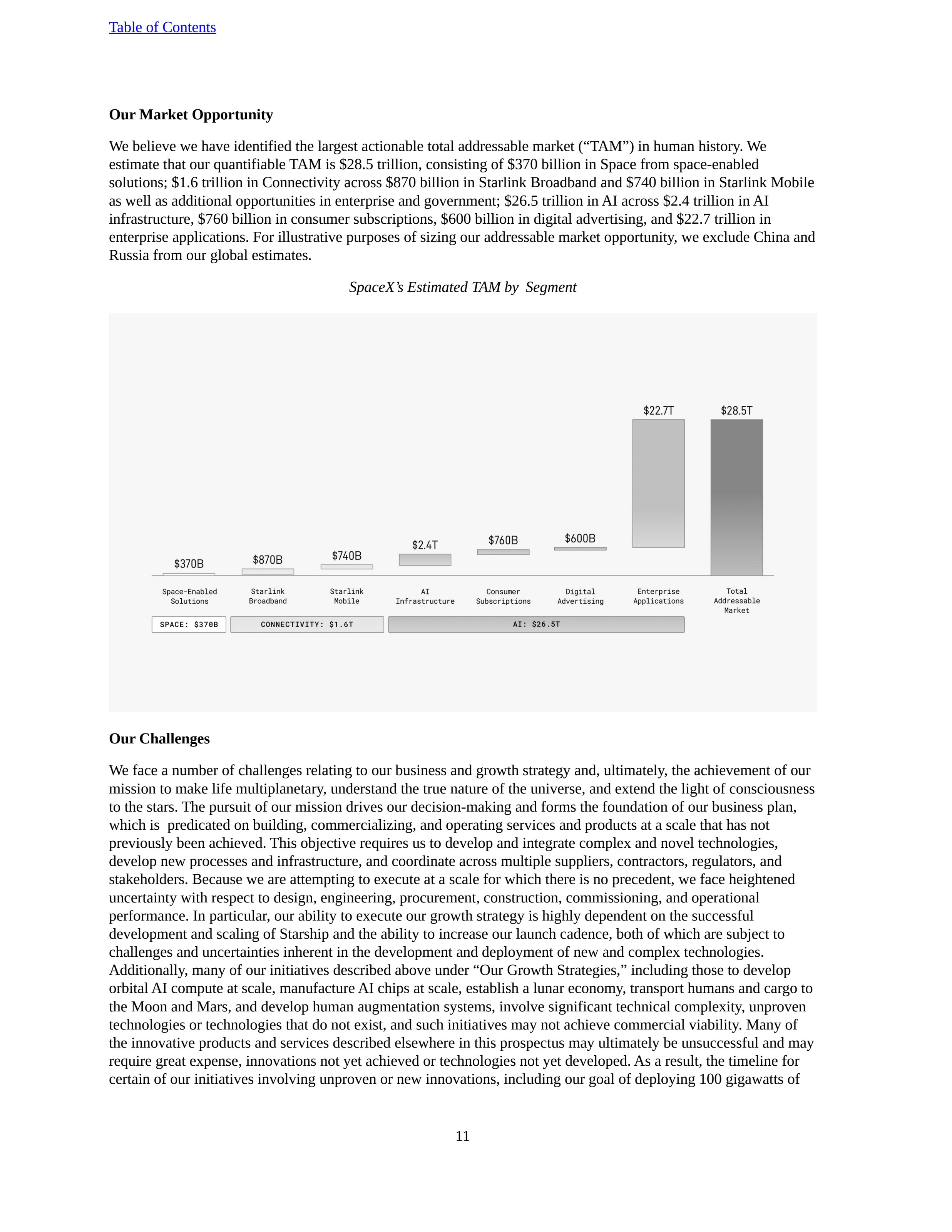
We believe we have identified the largest actionable total addressable market in human history. $28.5 trillion.
SpaceX S-1“Our Market Opportunity” · p. 11
Space
Space-Enabled Solutions
$370B
Connectivity
Starlink Broadband
$870B
Connectivity
Starlink Mobile
$740B
AI
AI Infrastructure
$2.4T
AI
Consumer Subscriptions
$760B
AI
Digital Advertising
$600B
AI
Enterprise Applications
$22.7T
Total Addressable Market
$28.5T

Source: S-1, “Our Market Opportunity,” p. 11. Excludes China and Russia per the filing's methodology.

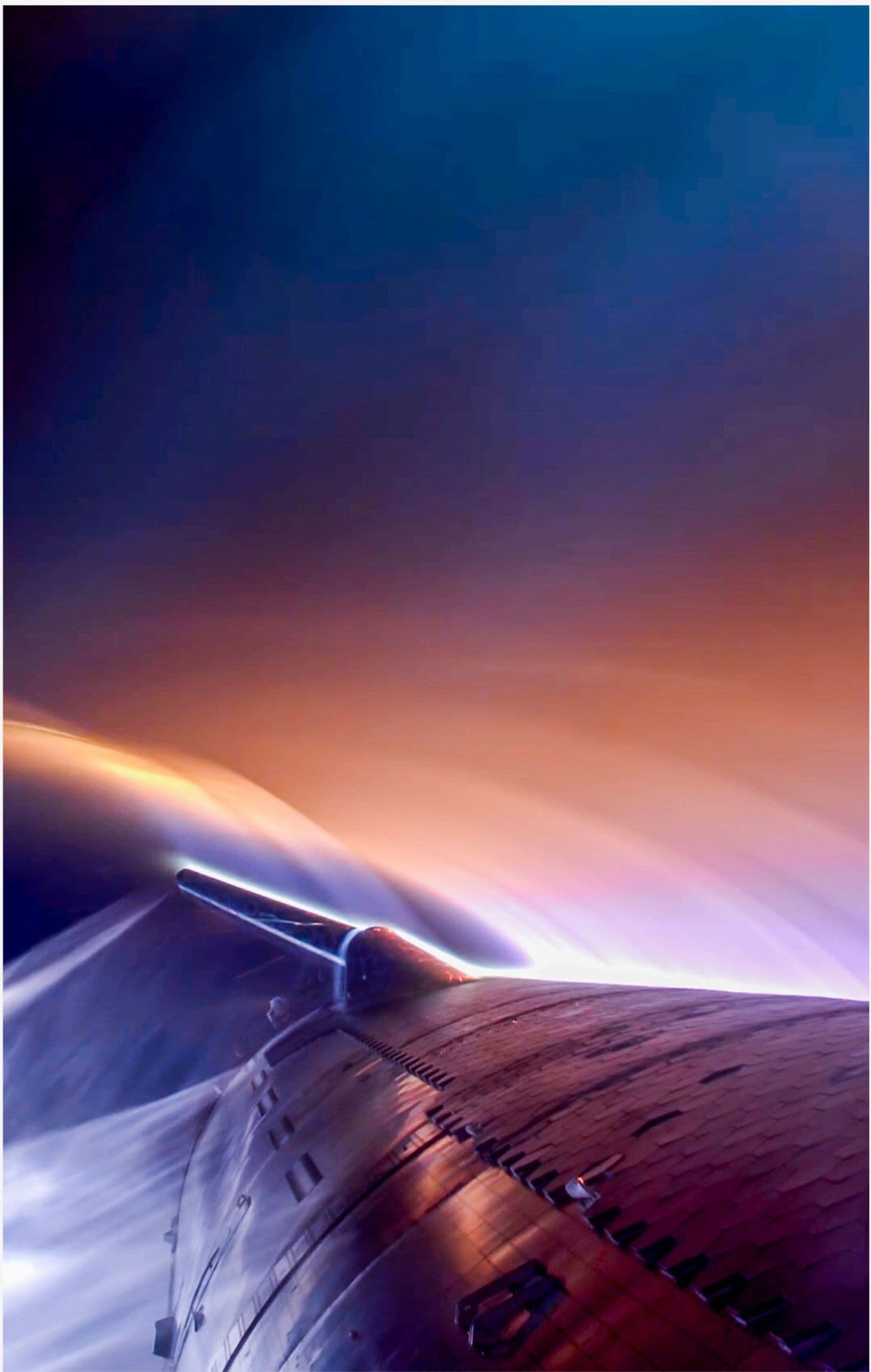
Top view of Starship during atmospheric re-entry, the body glowing pink-orange against darkening sky as plasma flames slide along its fins.
Chapter VII

Risks

Chapter VIIThe six pages the S-1 doesn’t want you to skim

What could go extremely wrong.

Every prospectus contains a Risk Factors section. Most of them read like compliance theater. SpaceX's reads like a thriller: anti-satellite weapons, cascading orbital debris, dual-class voting power, no key-person insurance on the founder, and orbital AI compute infrastructure that has never been tested in real conditions.

The filing's Risk Factors section runs sixty pages. Below are the ones most likely to keep an underwriter awake at night, ranked by severity and category. Click any row to expand the summary and the verbatim source quote.

Mission

Starship has not yet reached scale.

If Starship fails to achieve full reusability and the required launch cadence, the V3 Starlink rollout, satellite-to-mobile expansion, and the entire orbital AI compute plan delay with it.

AI compute satellites at scale need full Starship reusability to be economically compelling.
S-1 · Risk Factors · p. 27
Governance

We depend on Mr. Musk.

Governance

Public investors will hold a vote, not a voice.

Technical

No one has ever operated AI compute in orbit.

Mission

In-orbit refueling is not yet demonstrated.

Regulatory

Starlink runs on borrowed spectrum.

Geopolitical

Foreign governments have discussed anti-satellite weapons.

AI

AI products are subject to regulators in every market.

Technical

Cascading debris could lock us out of our own orbits.

Financial

Capex outruns operating cash flow.

Technical

We do not insure our satellites or launch vehicles.

Financial

Accumulated deficit: $41.3B.

Mission

Many of the target markets do not exist yet.

Technical

AI runs on purchase orders, not contracts.

Plain language

You are buying equity in a company whose value is dominated by two unbuilt futures — Starship at full reuse and orbital AI compute — and one founder whose attention is the most contested resource on Earth.

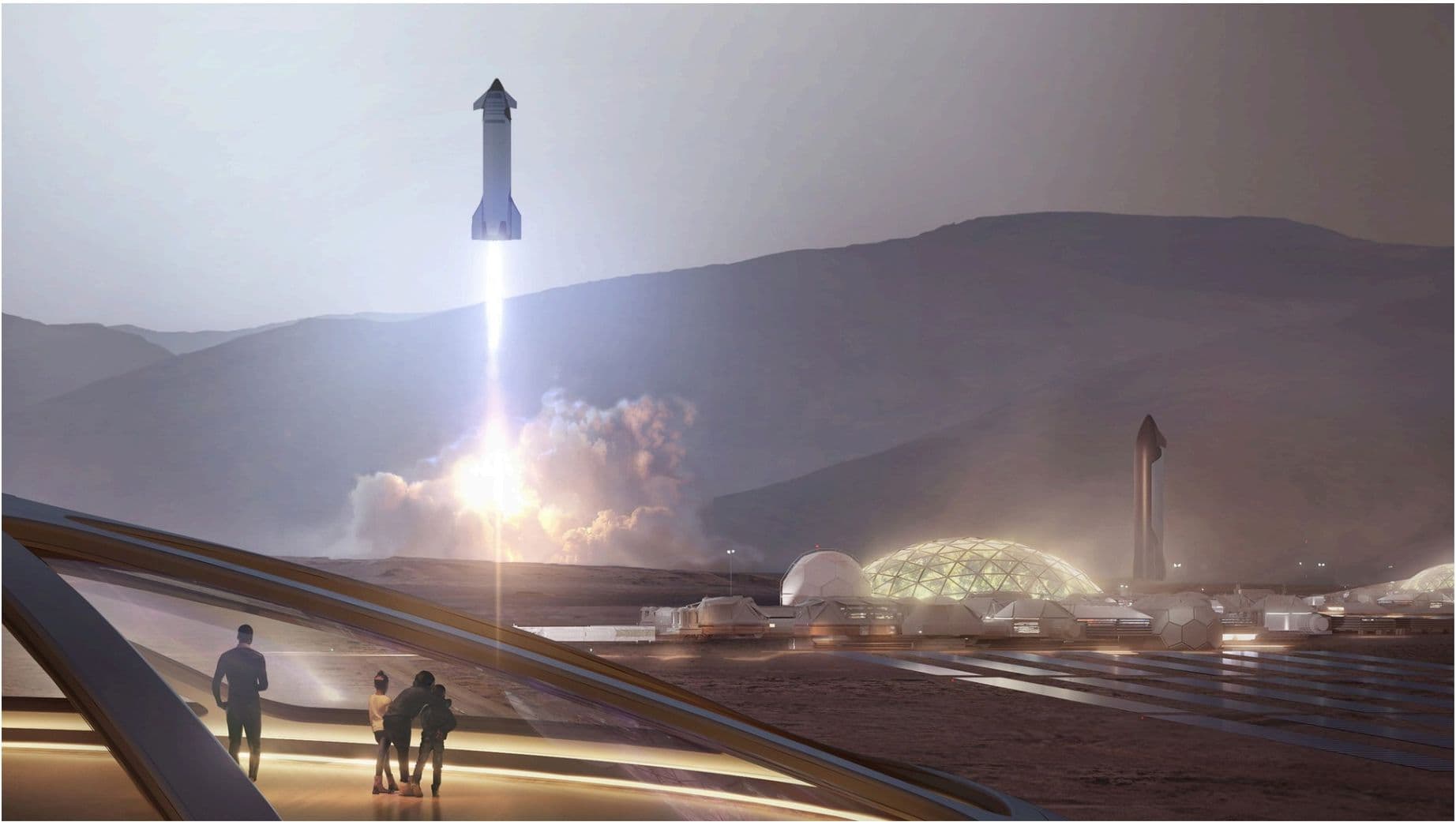
Concept art of a Mars colony at dusk — a Starship lifting off in the middle distance, geodesic domes to the right, a family in the foreground looking out from curved gold-trimmed architecture.
Chapter VIII

Future

Chapter VIIIWhat the IPO is being raised to build

From Falcon 1 to Base Alpha. Forty-eight years of roadmap.

Every IPO has a roadmap slide. SpaceX's starts in 2002 and doesn't finish in anyone's lifetime. Scroll horizontally through it. Some of it has already happened. Some of it should happen by the next presidential cycle. The last entry is the one the whole company is structured to make plausible.
Achieved·Space·01 / 20
2002

SpaceX founded

Incorporated as Space Exploration Technologies Corp. in Delaware, March 14.

Achieved·Space·02 / 20
2008

Falcon 1 reaches orbit

First private company to put a liquid-fueled rocket into Earth orbit.

Achieved·Space·03 / 20
2010

Falcon 9 commercial debut

Launch cost ≈ $2,700/kg — 85% below the historical average.

Achieved·Space·04 / 20
2012

Dragon docks with ISS

First commercial spacecraft to dock with the International Space Station.

Achieved·Space·05 / 20
2015

First booster recovery

December 2015 — Falcon 9 first stage lands back on Earth. Establishes a 10-year lead.

Achieved·Space·06 / 20
2017

Booster refly

First reflight of an orbital-class booster. Reusability becomes routine.

Achieved·Space·07 / 20
2018

Falcon Heavy + Roadster

First Falcon Heavy lifts a Tesla Roadster into orbit around the Sun. Space segment EBITDA-positive.

Achieved·Connectivity·08 / 20
2019

Starlink begins deployment

First operational Starlink satellites enter LEO.

Achieved·Space·09 / 20
2020

Crew Dragon Demo-2

First private crewed orbital launch — restores U.S. ability to launch astronauts.

Achieved·Connectivity·10 / 20
2022

Consumer phased-array terminals

First company to manufacture consumer-grade phased-array user terminals at scale.

Achieved·Space·11 / 20
2023

Starship first flight + Connectivity profitable

Starship integrated flight test. Connectivity segment EBITDA-positive on a sustained basis.

Achieved·Space·12 / 20
2024

Chopstick-arm catch

Launch tower “chopstick” arms catch a returning Super Heavy booster mid-air.

Achieved·Connectivity·13 / 20
2025

Starlink Mobile constellation deployed

First large-scale LEO satellite-to-mobile constellation.

Achieved·AI·14 / 20
2026

xAI acquired + IPO filed

xAI merged into SpaceX. COLOSSUS + COLOSSUS II reach 1.0 GW. Form S-1 filed May 20.

Planned·Space·15 / 20
2026 H2

Starship V3 to orbit

Expected first payload delivery to orbit, including V3 Starlink satellites — up to 60 per launch.

Planned·Connectivity·16 / 20
2027

EchoStar spectrum closes

$19.6B AWS-3, AWS-4, and H-block spectrum acquisition expected to close ~November.

Planned·AI·17 / 20
2028

First orbital AI compute satellites

Initial deployment of orbital data-center satellites in Sun-synchronous orbit.

Stretch·18 / 20
2030s

Lunar economy

Cargo to the Moon, surface industrialization, factory pilot for AI compute satellites.

Stretch·19 / 20
2030s+

First crewed Mars mission

Starship-class crew transport to Mars in a transfer window.

Stretch·20 / 20
Long term

Kardashev Type II

Harnessing the full energy output of the Sun — the stated north star of the filing.

Timeline
01 / 20
We believe rocket launches and landings should be as routine and commonplace as airplanes taking off and landing.
SpaceX S-1Business · p. 131
We expect to begin deploying our orbital AI compute satellites as early as 2028.
SpaceX S-1Prospectus Summary · p. 3
Our plans to deploy large-scale orbital infrastructure, including orbital AI compute systems, will require the operation of very large satellite constellations, potentially numbering up to one million satellites.
SpaceX S-1Risk Factors · p. 27
Our goal over time is to launch 100 gigawatts of compute to space each year.
SpaceX S-1MD&A — Drivers · p. 96
Our initial efforts will prioritize lunar cargo landings and returning Americans to the Moon, followed by expanded crewed missions that we believe can establish a continuous flow of cargo and humans between Earth and the lunar surface.
SpaceX S-1Business — Future Markets · p. 165
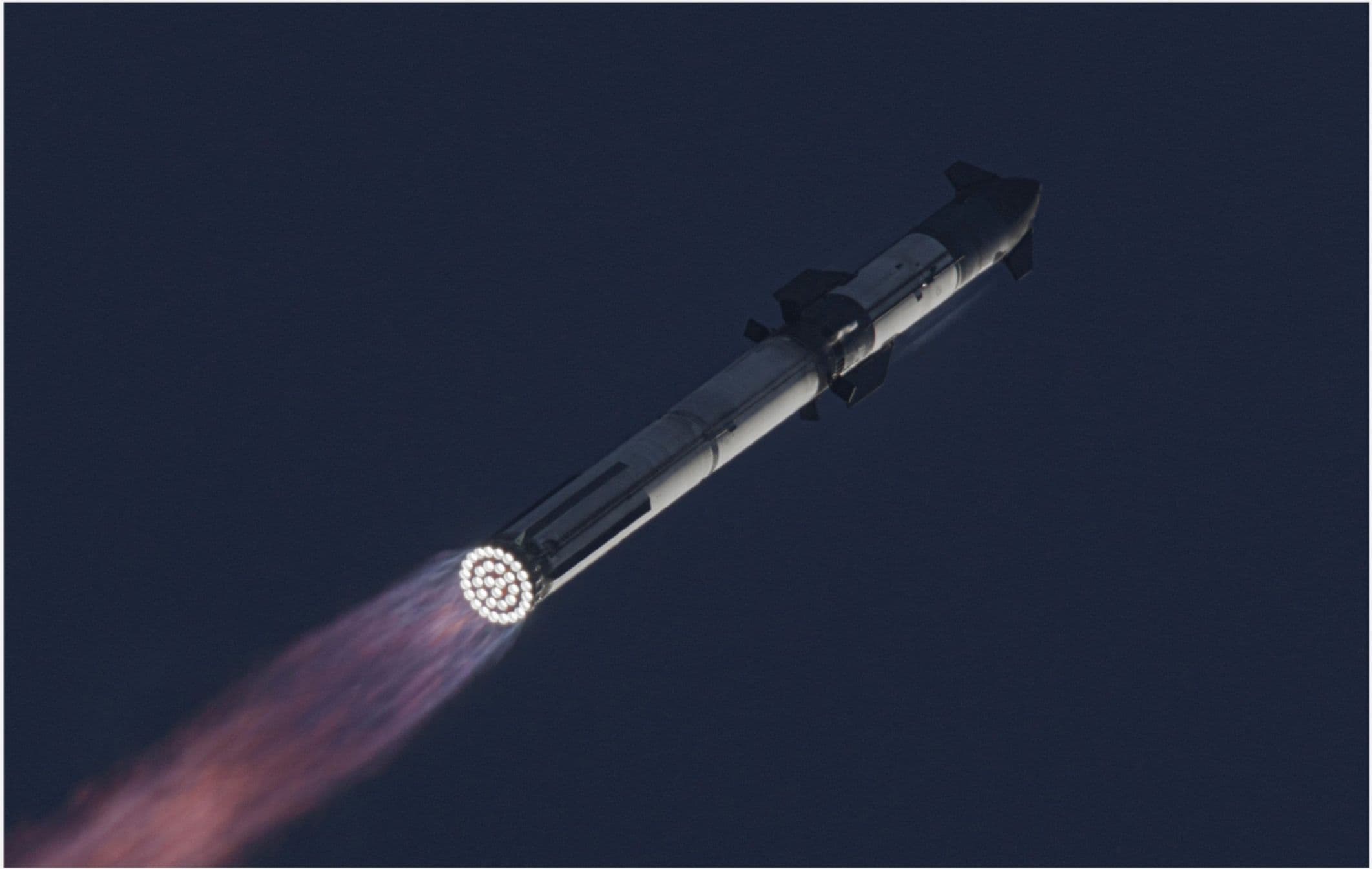
Starship in flight, the ring of 33 Raptor engine nozzles glowing pink against deep blue sky.
Our plans to deploy large-scale orbital infrastructure will require the operation of very large satellite constellations, potentially numbering up to one million satellites.
SpaceX S-1Risk Factors · p. 27
The closing image

Pick your timeline.
Place your bet.

If Starship works at scale, the launch industry is a footnote and SpaceX runs the new physics layer of the economy. If Starlink keeps compounding, it's a trillion-dollar ISP within the decade. If orbital AI compute happens at all, it happens here.

And if any of those doesn't happen, you own equity in an extraordinarily cool aerospace contractor.

One more thing.

You're holding the entire S-1.

Four hundred and seven pages. Read once, by a machine.
Here's how the film was made.

Keep scrolling
An overhead Starlink satellite stack flying over an Earth surface — used here as the visual backdrop for the parse section.
Chapter IX · Colophon

The Parse

Chapter IXHow the film was made

Four hundred and seven pages. Read once, by a machine.

Every figure on the previous eight chapters comes from a single PDF: the SpaceX Form S-1, 407 pages, filed with the SEC on May 20, 2026. We didn't hand-transcribe any of it. The entire filing was parsed by LlamaParse into structured markdown, JSON layout blocks, and extracted images — then queried into the figures, quotes, and photographs you scrolled past.
Pages parsed
407.0
Layout items
3.8K
headings, paragraphs, tables, lists
Tables extracted
177.0
with HTML + CSV + bboxes
Images extracted
98.0
photos and charts
Scene 01 · The demonstration

One page in. Structured output.

Three sample pages from the filing — pick a tab. Each parsed item is overlaid on the rendered page with a colored bounding box and listed on the right with the actual extracted value. Hover either side; the highlight pairs across.

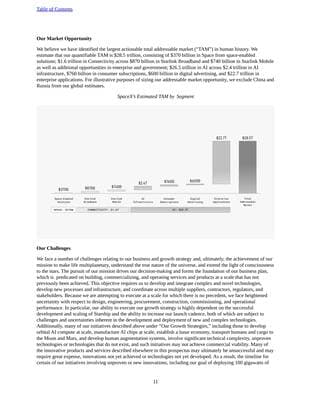
The Market Opportunity page — heading, prose, a stacked bar chart, and a complex multi-row table with rowspans.

Input · rendered page
612 × 792 pt
Rendered page 38 of the SpaceX S-1
Output · parsed items
6 items · 6 bboxes
headingtexttablelistheaderfooterlink
Scene 02 · Every page

The whole filing. At a glance.

Every page of the parsed document. Hover any tile to see its index. The raw output for the full 407-page filing fits in a 4.5MB JSON. We wrote zero layout code.

404 page renders · 6 rows · tap to enlarge
Tap any page
Built with

If you have a PDF, you have the same starting material.

LlamaParse is the parsing layer underneath this site. It turns long, layout-heavy documents — S-1s, 10-Ks, research papers, contracts, decks — into the structured data you can actually build with.